Reviewed 10 October 2026. This guide explains credit-report checks and original budgeting examples. It does not calculate a CIBIL score or promise a specific increase.
To increase your CIBIL score, first identify what is holding your credit profile back: late payments, high reported balances, frequent applications or incorrect entries. Then work on the relevant issue and verify the updated report. A score of 600, 650 or 700 is a starting point for investigation, not enough information to prescribe the same fix to everyone.
CIBIL names payment history, credit utilisation, age of credit and enquiries as important factors. Its guidance stresses timely payments, low balances and cautious borrowing. Source: CIBIL's score and report guidance. The checklists below turn those principles into tasks you can organise; they are not CIBIL's scoring formula.
How to increase a CIBIL score from 600 or 650 to 700 or 750
Begin with the full report rather than searching for a fixed number of points. Two people with a score of 650 can have very different histories: one may have an incorrect overdue entry, another may have accurate late payments, and another may be using much of their card limit. Their next steps depend on those facts.
| Question | What to investigate | Useful next task |
|---|---|---|
| My score is near 600; how do I reach 700? | Overdue accounts, repayment entries and account ownership | List actual dues and any evidence-backed errors before seeking new credit |
| How do I improve 650 to 750? | Reported card balances, past delays and recent applications | Identify the issue visible in your report and plan the appropriate repayment or correction |
| I have 700; can I reach 750? | Current report, affordability and the lender's actual requirements | Maintain repayments and check eligibility rather than applying repeatedly to test it |
| The report shows NA or NH | Whether there is enough reported credit history to score | Read the status explanation and confirm that existing accounts are correctly reported |
These are examples of investigation, not official approval bands. CIBIL describes NA/NH as potentially reflecting insufficient history or inactivity. Source: CIBIL contact FAQs. Do not treat a missing numeric score as an overdue loan by itself.
Step 1: read your CIBIL report carefully
CIBIL provides one free score and report per calendar year through its official channel. Get the official free annual CIBIL report. A free annual entitlement is different from unlimited free refreshes; check the service terms before paying for additional access.
- Match account ownership: identify which loan or card each entry relates to, including any partner-lender name on an app-based loan.
- Check payments: compare reported overdue amounts and late-payment entries with your receipts and statements.
- Check balances and limits: note the date reported before comparing an older report with today's bank balance.
- Check status: read open, closed, settled or other remarks alongside the lender's records.
- Check enquiries: match unfamiliar entries with applications you actually made.
Keep a private worksheet with the report date, entry, evidence and next action. If a field is inaccurate, use our CIBIL dispute guide. A genuine correction request is different from asking someone to erase accurate repayment history.
Paid a loan but the report still shows old information? Check the lender statement, account reporting date and the date of your displayed report. Our RBI CIBIL rules guide: report updates and complaint checklist explains the current reporting process, free annual report and evidence to keep for a correction request.
Step 2: organise payments you can sustain
Make a calendar showing each lender's due date and required payment. Check that a standing instruction actually succeeded; setting one up and leaving insufficient funds does not complete the payment. If you cannot meet an obligation, contact the lender early about your available options and obtain the terms in writing.
For credit cards, distinguish the minimum amount due from the total amount due. CIBIL's credit-mistakes article explains that repeatedly paying only the minimum can leave a high balance and interest costs. Source: CIBIL on common credit mistakes. Read your issuer's statement and interest rules.
Original budget example: take-home income is ₹50,000; essential spending is ₹30,000; other contracted repayments are ₹10,000. That leaves ₹10,000 before irregular costs and additional card repayment. If the card's total bill is ₹18,000, the budget has a shortfall. Identify spending you can actually reduce and speak to the issuer instead of assuming a new loan solves the problem.
If a UPI payment for a bill fails after a debit, keep the transaction record and verify the lender's receipt separately. Our UPI failed-payment refund and complaint guide explains the evidence and official support route. When changing a recurring payment method, use the UPI AutoPay cancellation checklist and arrange any required alternative with the provider. Cancelling a mandate does not settle an outstanding bill; a failed transfer alone does not establish what a lender reported to CIBIL.
Step 3: calculate credit utilisation correctly
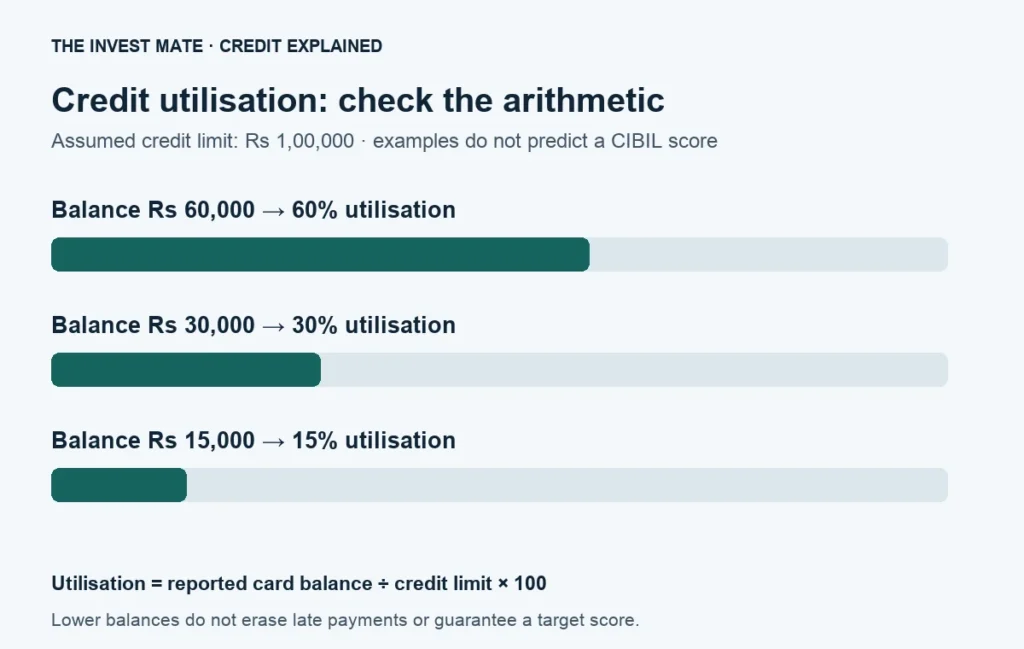
Credit utilisation illustration = reported credit-card balance ÷ card limit × 100. With a ₹1 lakh limit, a ₹60,000 balance represents 60%; ₹30,000 represents 30%; ₹15,000 represents 15%. These are balance calculations, not outputs from a score simulator.
| Reported balance | Utilisation | Reduction from ₹60,000 balance |
|---|---|---|
| ₹60,000 | 60% | Starting illustration |
| ₹40,000 | 40% | ₹20,000 |
| ₹30,000 | 30% | ₹30,000 |
| ₹15,000 | 15% | ₹45,000 |
CIBIL's card guidance calls 30% a healthy utilisation ratio. Source: CIBIL credit-card guidance. Treat it as guidance, not a scoring switch: crossing below 30% does not guarantee 700 or 750, and it does not remove the rest of your history.
Repay what your budget supports → lender reports the balance → check the report date and updated entry → assess the complete profile
Check individual cards as well as the combined arithmetic. Suppose Card A has a ₹50,000 limit and ₹40,000 balance: 80%. Card B has a ₹1 lakh limit and no balance: 0%. Combined balances of ₹40,000 against ₹1.5 lakh limits equal about 26.7%, but that aggregate does not erase Card A's high balance. This example does not establish the model's weighting of either measure.
Step 4: apply for new credit cautiously
Before applying, compare eligibility, fees, repayment costs and the borrowing purpose. Avoid sending several applications simply to discover which one succeeds. Keep a record of the lender, product, application date and consent given so later report enquiries can be matched.
Checking your own score is different from making a credit application. Read our self-check vs lender enquiry guide. Do not take an unnecessary loan merely to create a different credit mix or to chase a target number.
Step 5: understand settled vs closed accounts
CIBIL's explanation distinguishes a settlement below the complete amount owed from full repayment in its example. Source: CIBIL on settled status. If you want to address your own status, ask the lender for the amount, reporting treatment and documentation in writing before acting. An agent's promise is not a lender confirmation.
Preserve payment receipts and any closure or no-dues document. Check the refreshed entry against the agreed outcome. Do not assume that changing a status will remove every older late-payment entry or guarantee approval.
If your loan is paid but the report still says settled, use our settled vs closed in CIBIL guide for a document checklist, an original example and a lender-clarification message. Confirm any proposed amount and reporting treatment in writing before making a further payment.
A 30-day organisation plan, not a score-increase deadline
| Period | Task | Evidence to keep |
|---|---|---|
| Days 1–7 | Read the report, list dues and separate accurate entries from suspected errors | Dated report and account worksheet |
| Days 8–14 | Follow the payment calendar and submit any supported correction request | Receipts, complaint references and lender replies |
| Days 15–21 | Review cash flow, reported balances and upcoming obligations | Updated budget and reporting dates |
| Days 22–30 | Track unresolved questions and compare refreshed information when available | Dispute status and a field-by-field comparison |
Your repayment obligations continue throughout this plan. The dates organise your work; they do not promise a 600-to-750 jump in a month. Reporting, correction and rebuilding credit history are separate processes.
Frequently asked questions
How can I make my CIBIL score 700?
Find the issue in your complete report, address actual dues or inaccuracies and maintain repayments. No responsible checklist can promise that a particular action will produce exactly 700.
How long does it take to increase CIBIL score from 600 to 750?
There is no universal timeline. The starting history, subsequent credit behaviour and information reported determine the outcome. A lender reporting update is not a guaranteed score increase.
Can I improve my CIBIL score without a new loan?
Start with existing obligations, affordable balances and report accuracy. Taking unnecessary debt to chase a score can create additional cost and payment risk.
Does checking CIBIL score reduce it?
CIBIL says checking your own score does not lower it. A lender's credit-application enquiry is different; our linked guide explains the distinction.
Will a 750 CIBIL score guarantee a loan?
No. CIBIL's score brochure explains that approval belongs to the lender. Income, obligations and product eligibility can also matter. Source: CIBIL score brochure.
Related tools: use the monthly budget planner to organise cash flow and the EMI calculator to understand an offered repayment schedule. Neither tool predicts a CIBIL score.
Sources reviewed 10 October 2026. This independently written educational guide is not affiliated with TransUnion CIBIL. Tables, examples and the action plan are original; no scoring weights, paid credit-repair service or guaranteed results are offered.
Good score, but still rejected?
If your score is already 750 or higher, focus on the lender’s reason, documented income, existing EMIs and full report. Our 750 CIBIL score but loan rejected guide compares two ₹50,000-income examples and explains what to clarify before reapplying. For a missed card-bill date, see one-day-late card payment: CIBIL, late fee and interest.