Checked 12 October 2026. Paying the minimum amount due on a credit card does not mean you have paid the full bill. The unpaid balance can continue attracting finance charges. Before choosing a payment amount, read three things together: the total amount due, the minimum amount due and the payment due date.
Quick answer: minimum due is the required minimum shown on your statement; total due is the full billed amount. Meeting the minimum can help you avoid a late-payment charge under your issuer's terms, but it does not automatically preserve the interest-free period. New purchases can also attract interest when a balance is carried forward. Check your card's terms and any existing arrears.
Paid the bill but the payment has not appeared? Follow the credit card bill paid but not reflected guide to reconcile the receipt, bank debit and incoming card payment, with a due-date checklist and complaint template.
Minimum due vs total due: what is the difference?
| Statement field | Meaning | Check before paying |
|---|---|---|
| Total amount due | The full billed amount for that statement. | Previous balance, purchases, instalments and charges. |
| Minimum amount due | The issuer's required minimum payment. | Its exact formula, overdue components and due date. |
| Current outstanding | The account balance displayed at the time you check. | It may include transactions made after the statement date. |
Suppose a statement shows total due of ₹30,000 and minimum due of ₹1,500. Paying ₹1,500 leaves ₹28,500 of that bill unpaid before any later interest, fees, refunds or transactions. Paying ₹10,000 is more than the minimum, but it still does not clear the full statement amount. Keep the statement and confirm how the issuer allocates the payment.
Is the minimum amount always 5%?
No. Issuer formulas differ. HSBC's explanation says the calculation varies, while SBI Card's current personal-card MITC defines minimum due using all GST, EMI amounts, fees, finance charges and any overlimit amount, plus 2% of the remaining balance. A percentage quoted in a general blog is not a substitute for the minimum printed on your own bill. HSBC explanation · SBI Card MITC, minimum-due definition.
Here is an independent illustration of that type of formula, using hypothetical statement entries and no overlimit balance. The tax entry is an assumed amount already shown on the bill, not a tax-rate calculation.
| Illustrative entry | Statement amount | Included in this example's minimum |
|---|---|---|
| Remaining retail balance | ₹30,000 | 2% = ₹600 |
| Finance charges | ₹900 | ₹900 |
| GST already billed | ₹250 | ₹250 |
| Fees | ₹500 | ₹500 |
| EMI amount | ₹2,500 | ₹2,500 |
| Total | ₹34,150 | ₹4,750 |
These entries are not a real customer statement. Other issuer formulas, previous overdue payments and card-specific conditions can change the result. The useful lesson is to inspect the breakup rather than assume that a ₹30,000 purchase balance always means a ₹1,500 required payment.
What happens if I pay only the minimum due?
The remaining debt rolls forward. SBI Card's agreement describes interest-free eligibility conditions and finance charges on new purchases when those conditions are not met. HDFC Bank also explains that paying only the minimum carries the remaining balance into the next cycle. SBI Card agreement · HDFC Bank explanation.
Interest need not be a simple percentage of only the balance left on the due date. Transaction dates, daily-balance calculations, payment dates and allocation rules can matter. If you have been revolving a balance, ask whether residual finance charges will appear even after a later payment clears the amount currently displayed.
Total due, minimum due, due date and charges.
Use a repayment amount you can sustain.
Check posting, allocation and the next bill.
₹30,000 balance: how extra payments change repayment
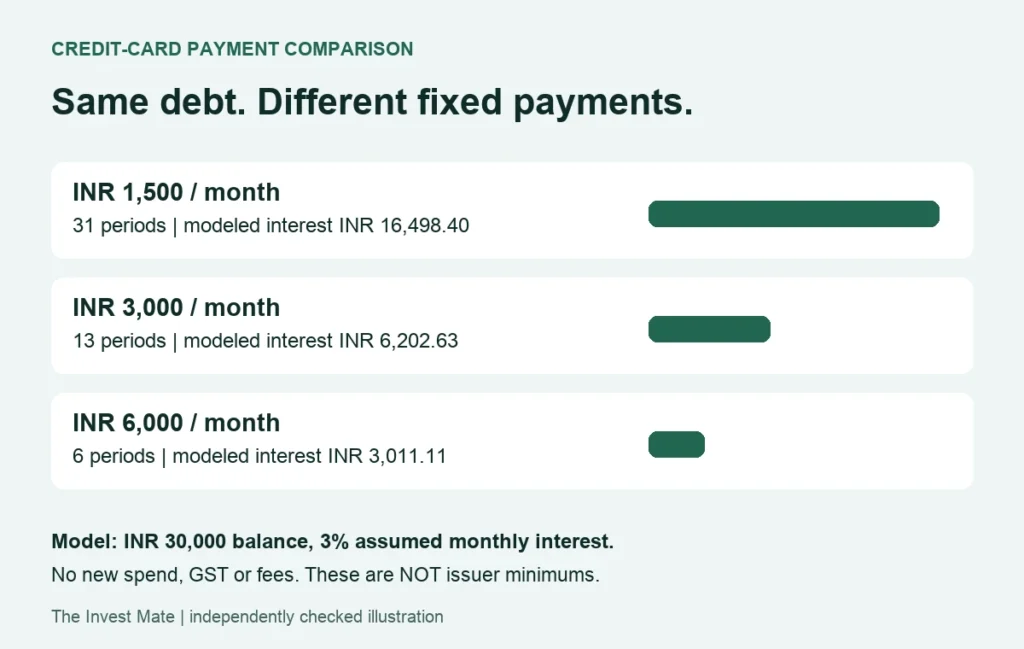
This is a simplified mathematical model, not an issuer bill calculation. It starts with ₹30,000 debt, adds a hypothetical 3% interest at the start of each monthly period, then subtracts a fixed payment. There are no new purchases, GST, fees, cash advances or missed payments. The last payment is capped at the amount remaining. Monthly interest is rounded to paise. The assumed rate is not a current card-rate quote.
| Fixed monthly payment | Periods to repay | Modeled interest | Total paid |
|---|---|---|---|
| ₹1,500 | 31 months | ₹16,498.40 | ₹46,498.40 |
| ₹3,000 | 13 months | ₹6,202.63 | ₹36,202.63 |
| ₹6,000 | 6 months | ₹3,011.11 | ₹33,011.11 |
₹1,500 here is a fixed payment, not a claim that an actual issuer's minimum stays constant. In the first modeled month, ₹900 interest is added and ₹1,500 paid: the balance falls by only ₹600, to ₹29,400. With a ₹3,000 payment it falls to ₹27,900. Real statements may charge more because this model excludes tax and fees, and the timing method differs.
The model helps you see why payment capacity matters. It does not tell you to promise a ₹6,000 payment if your budget cannot support it. Use the monthly budget planner to separate essential costs and existing obligations before comparing amounts.
Does paying minimum due affect CIBIL?
Do not treat “minimum paid” as a guarantee that your score stays unchanged. CIBIL identifies payment history, utilisation, credit age and enquiries as relevant factors. A large carried balance can keep utilisation high even if you meet the issuer's minimum. See CIBIL's score-factor explanation and our credit-utilisation examples.
For an arithmetic illustration, ₹30,000 used against a ₹50,000 limit is 60% utilisation. If the balance becomes ₹29,400 and the limit stays the same, utilisation is 58.8%. It has fallen, but remains substantial. These percentages do not predict a score change or establish a universal approval threshold.
If you cannot pay the total due this month
- Read the required minimum and due date. Check past dues and the issuer's current payment instructions.
- Work out a sustainable amount. Account for essential spending and other repayment obligations.
- Contact the issuer early. Ask about repayment options, full cost, processing charges and eligibility; obtain terms in writing.
- Compare complete costs. A smaller EMI or lower advertised rate can hide a longer tenure or fees. Our EMI cost comparison guide shows what to record.
- Check payment posting. Save the receipt and confirm it reached the correct card account.
If you want an explanation from the issuer, ask: “Please show how my minimum was calculated, how this payment is allocated, which balances attract interest and what amount restores interest-free eligibility under my card terms.” Do not share OTPs or your full card details with people offering to clear the debt.
Frequently asked questions
Is paying more than the minimum enough to avoid interest?
It reduces debt, but a partial payment can still leave a revolving balance. Interest-free eligibility depends on your card terms and previous balance history.
Can I keep making new purchases while carrying debt?
New purchases can add debt and may attract finance charges when interest-free conditions are not met. Check the agreement before assuming a fresh purchase gets a free period.
Is credit-card EMI automatically cheaper?
No. Compare the rate, fees, tax treatment, tenure and total repayment shown in the offer. Do not compare only monthly instalments.
Why did interest appear after I paid the displayed outstanding?
Check residual finance charges, payment posting and new transactions. Ask for the calculation period and reconciliation rather than guessing from the app balance alone.
What if I paid but the credit report still shows an old balance?
Compare account reporting dates and a fresh report. Our credit-report update guide explains the reporting and complaint process.
Sources and scope
Issuer references checked 12 October 2026: SBI Card MITC, SBI Card agreement, HSBC minimum-due guide, HDFC Bank guide and CIBIL. Examples and repayment calculations are original illustrations. This guide does not replace your statement or provide personalised borrowing advice.
Already missed the card-bill due date?
The amount paid and the date it reached the card account both matter. Read credit-card bill paid one day late for separate explanations of late fees, interest and CIBIL reporting, with full-bill, minimum-due and pending-payment examples.
Already missed the card-bill due date?
The amount paid and the date it reached the card account both matter. Read credit-card bill paid one day late for separate explanations of late fees, interest and CIBIL reporting, with full-bill, minimum-due and pending-payment examples.