Checked 12 October 2026. Paid a credit-card bill or closed a loan, but your CIBIL report still shows the old balance? Start by checking the account's reporting date. Your bank receiving a payment, a credit bureau receiving data and an app displaying a refreshed report are different events.
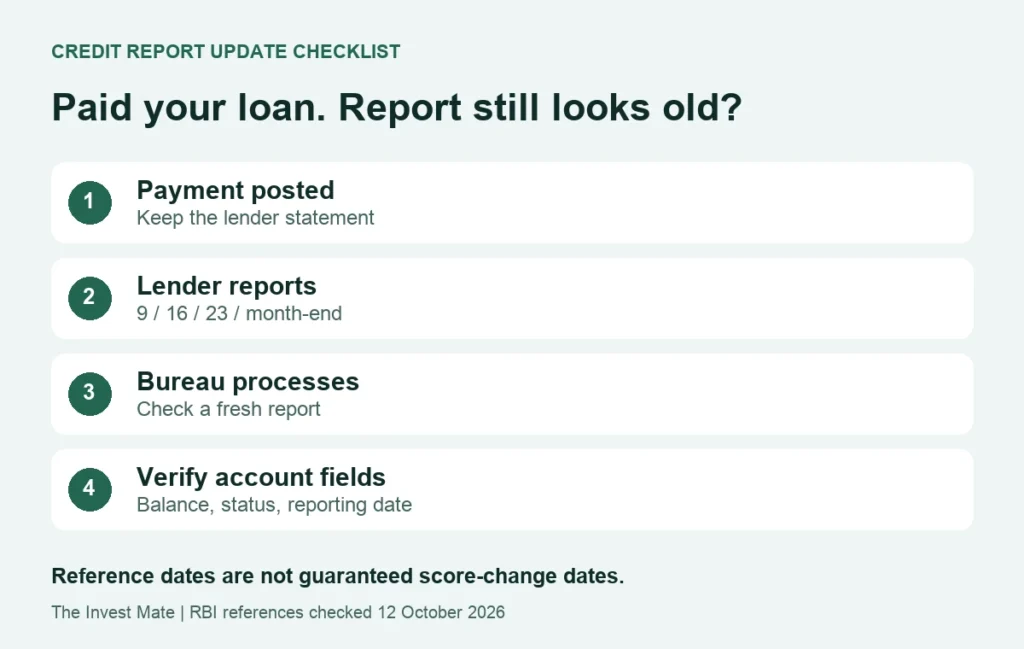
Quick answer: RBI's reporting framework effective from 1 July 2026 uses four monthly reference dates: 9, 16, 23 and the last day of the month. These are data-reporting dates, not a promise that your score changes on those dates. You can request a free annual full credit report and raise a correction complaint when account information is wrong.
RBI CIBIL rules in 2026: what actually changed?
The December 2025 amendment took effect on 1 July 2026. Incremental credit information for the 9th, 16th and 23rd must be submitted within four calendar days; the month-end full file is due by the 5th of the next month. Credit bureaus have three calendar days from receipt to ingest files under their acceptance rules and provide rejection reports. RBI's enacted amendment.
Save the receipt and lender statement.
Check the relevant reference date.
Compare a freshly generated report.
Balance, status and reporting date matter.
A submission rejected for data problems can require correction. An app may also be showing an older saved report. Avoid interpreting a score-only screen as proof that the lender failed to report a payment.
Reporting date versus payment date: a simple example
Suppose your lender's statement confirms a repayment posted on 10 October. When you compare reports, first check whether the account information relates to a date before or after that payment. The following is a checking example, not a guaranteed personal update schedule.
| What you see | What it establishes | What to check next |
|---|---|---|
| Receipt dated 10 October | You have evidence of the transaction. | Did the lender post it to the correct account? |
| Account data reported as of 9 October | The account snapshot predates the payment. | Compare a subsequent account snapshot. |
| An app checked on 20 October | You opened the app on that day. | What are its report-generation and account-reporting dates? |
Write down all three dates rather than repeatedly refreshing a score widget. If a later report still conflicts with the lender statement, send the exact field, date and evidence to the lender or bureau. “My score is low” and “this paid account has an incorrect overdue amount” are different complaints.
How to get your free full CIBIL report
RBI requires a credit bureau to provide one authenticated electronic full report, including the score, per calendar year to an individual whose score is available with it. This is January–December, not a promise of unlimited free daily reports. See paragraph 21(7) of the current Credit Information Companies Directions.
- Start from the bureau's official website, such as CIBIL's free report route.
- Complete the identity checks yourself through its official process.
- Save the report date and the account entry you want to review.
- Compare account-level information with your lender's statement, rather than looking only at the score.
A paid monitoring plan can be a separate optional product. Check what is being offered before buying it. You do not need to publish your report, PAN, OTP or full account details on a finance blog to understand the rules.
Loan closed but still showing open: what should you check?
An account remaining in your credit history is different from an incorrect open status. CIBIL explains that closed accounts can remain as historical records. Its dispute guidance also covers wrong balances, missing payments and closed accounts incorrectly appearing open. CIBIL's dispute guide.
| Situation | Evidence to compare | Specific question to ask |
|---|---|---|
| Closed loan still marked open | Closure confirmation and latest account entry | Please confirm the closure date and status submitted. |
| Old balance after a payment | Posted payment, statement and reported balance/date | Does the report reflect this transaction? |
| Late-payment entry you believe is wrong | Due date, payment posting and monthly history | Please investigate this month's repayment entry. |
| Loan or enquiry you do not recognise | Lender name, account/enquiry details and your records | Please verify ownership and the basis of this entry. |
Keep your original documents. A receipt alone may not answer whether payment went to the correct account or posted before a due date. Ask for a written explanation when the lender's version differs from yours. Our CIBIL dispute walkthrough covers the detailed correction process.
Can you claim ₹100 per day for a delayed CIBIL complaint?
The compensation framework concerns delayed resolution of qualifying credit-information correction complaints beyond 30 calendar days from initial filing. It is not a payout simply because your score is below 700. The delay amount is ₹100 per calendar day, with responsibility allocated to the lender and/or bureau as applicable. CIBIL's compensation explanation.
RBI excludes certain categories, including score-computation/model disputes and cases already pending or decided in other specified forums. Check eligibility before making a demand. The current directions also specify crediting compensation within five working days of complaint resolution; working days and calendar days are different. RBI paragraphs 41(6)–41(8).
| Delay beyond the permitted period | Illustrative amount |
|---|---|
| 2 calendar days | 2 × ₹100 = ₹200 |
| 7 calendar days | 7 × ₹100 = ₹700 |
| 12 calendar days | 12 × ₹100 = ₹1,200 |
These examples calculate only the arithmetic. They do not establish your filing date, resolution date, entitlement or the responsible institution. Save the initial acknowledgement, responses and final report so the institution can explain the applicable calculation. Submit payout information only through the institution's official channel.
A complaint message you can adapt
Keep the request factual and limited to the entry you want checked. Replace the bracketed fields; do not send this sample without reviewing it.
Subject: Request to verify and correct credit-report information
I am requesting a review of [lender/account reference, masked where appropriate]. My report generated on [date] shows [specific balance/status/payment-history entry]. The lender statement or confirmation dated [date] shows [the information you believe is correct].
Please investigate the difference, confirm the account information submitted to the credit bureau, and provide a complaint reference. I have attached the relevant statement/confirmation through this official complaint channel. Please explain the action taken and provide the corrected report or reasons for rejecting the request.
If the complaint falls within the delayed-correction compensation framework, please confirm the applicable filing and resolution dates and any compensation calculation. My previous complaint reference is [reference, if any].
Send the complaint yourself to the relevant lender or bureau. Keep a simple log: date submitted, reference, documents provided, response date and next action. A second screenshot saying “still not fixed” is less useful than a comparison showing the precise old and new account fields.
Do the new RBI rules automatically increase your score?
More frequent reporting is a data-update process. It does not guarantee 700, 750, a fixed point increase or loan approval. Do not pay someone who promises to erase accurate history or produce a particular score immediately. For practical credit habits, see our guide to improving CIBIL score from 600, 650 or 700.
Frequently asked questions
Does my score update on every reporting reference date?
Not necessarily. A reference date, lender submission, bureau processing and your app's displayed report are separate steps. Verify account information and report freshness first.
Should a correctly closed loan disappear from my report?
No. The question is whether its status and balance are accurate. A historical account being visible is not the same as an incorrect open loan.
Is a loan rejection itself a credit-report error?
No. A lending decision and an incorrect credit-data entry are separate issues. Identify an actual discrepancy rather than assuming rejection proves the report is wrong.
Can checking my own report lower my score?
CIBIL distinguishes your own score check from a lender's credit-application enquiry. Read our self-check versus hard-enquiry guide.
What should I do if a complaint is rejected?
Review the reason and evidence. Ask the institution's official grievance channel for an explanation or escalation route. Keep the original reference and check the applicable external complaint scheme's eligibility before filing elsewhere.
Sources and scope
- RBI amendment issued 4 December 2025, effective 1 July 2026
- RBI Credit Information Companies Directions, updated 1 July 2026
- CIBIL: account corrections and historical records
- CIBIL: delayed-dispute compensation
Source references checked 12 October 2026. This guide explains consumer credit-report reporting and complaint steps; it does not assess your eligibility for a loan, decide a compensation claim or provide personalised legal or financial advice.