Reviewed 10 October 2026. This independently written guide explains self-checks and credit-application enquiries using official CIBIL references.
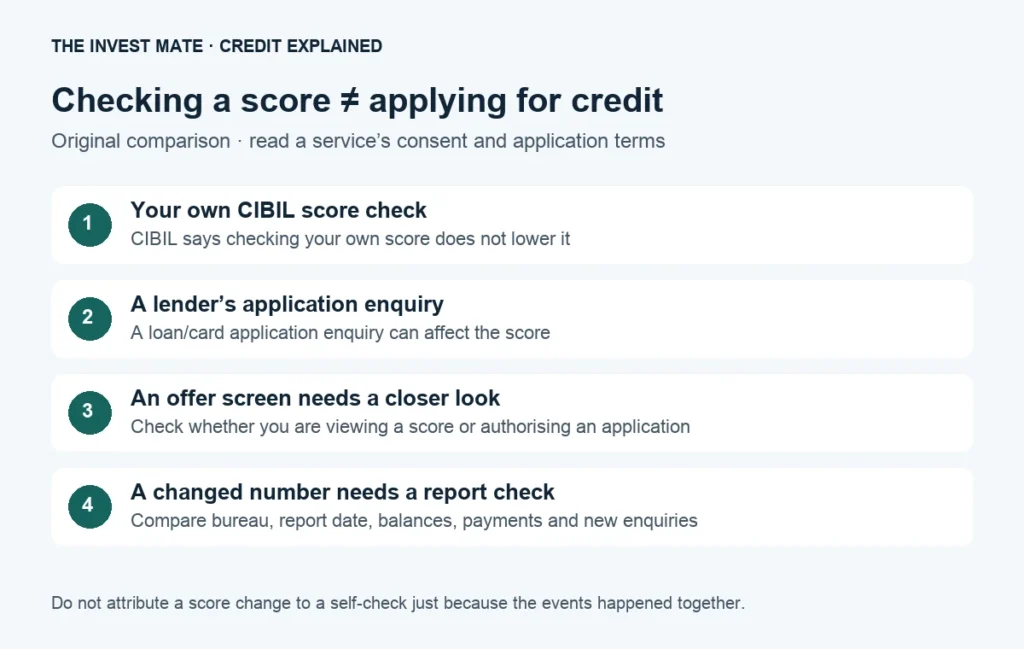
No—checking your own CIBIL score does not reduce it. CIBIL distinguishes your own soft enquiry from a lender's hard enquiry when processing a credit application, which can affect the score. Source: CIBIL's score explanation.
The practical question is what you authorised. Viewing your score and submitting a loan or credit-card application are different actions, even when they appear in the same app. Read the consent and service description before continuing from a score screen to an offer.
Soft enquiry vs hard enquiry: what is the difference?
| Action | What to understand | What to check first |
|---|---|---|
| Check your own CIBIL score | CIBIL says a self-check does not lower it | That you are using a score/report service |
| Apply for a loan or credit card | A lender application enquiry can affect it | Product, lender, terms and consent |
| View a credit offer in an app | The offer label alone does not establish the action | Whether proceeding authorises an application or credit enquiry |
| Raise a report-error dispute | The goal is to verify inaccurate information | The exact field and supporting evidence |
Do not assume every “eligibility check” or “pre-approved” screen uses the same process. Ask the provider what enquiry is made and whether proceeding submits an application. A lender name in a report should be matched to your actual consent and application records.
Why did my CIBIL score change after I checked it?
Two events happening close together do not prove that one caused the other. CIBIL identifies payments, utilisation, credit age and enquiries as score factors. Source: CIBIL score guidance. Check what information changed between reports.
- Confirm the bureau: compare CIBIL with CIBIL, rather than assuming every app displays the same bureau or model.
- Compare report dates: an older saved report and a refreshed report may contain different information.
- Review balances and payments: identify updated limits, balances, overdue amounts or repayment entries.
- Review applications: match newly shown lender enquiries with applications you made.
- Investigate inaccuracies: use a supported dispute if a particular entry is wrong.
Original example: you checked a report on Monday showing 720 and saw 710 in a newer report on Friday. Also suppose the newer report shows a higher card balance and a new loan application. Those facts identify things to investigate; they do not let you assign a fixed point effect to either entry. The act of checking your own score is not the evidence of a penalty.
Different score → compare bureau and date → inspect changed report entries → identify the actual question
How can I check my CIBIL score for free?
CIBIL's official channel provides one free score and report per calendar year; additional reports may require a subscription. Official free annual CIBIL score and report. The free entitlement and how often a paid plan can refresh are separate questions.
Open the official site yourself, use its registration or login process and read the terms before accepting any paid option. Enter identity information only in the intended service. You do not need to share a password, OTP or personal credit report with The Invest Mate to read this guide.
What if an unfamiliar lender enquiry appears?
CIBIL's consumer guidance explains that an enquiry records a lender's report access related to an application; it does not establish that a loan was disbursed. An app loan may use a partner lender name. Source: CIBIL consumer dispute guidance.
Match the lender and date with your application records. If it still does not belong to you, request verification through the official process. Our CIBIL dispute guide provides an evidence worksheet and complaint template.
Keep research and applications separate: compare costs and eligibility first, then submit an application you intend to make. Repeated applications solely to test approval can create avoidable enquiries.
Frequently asked questions
Does checking CIBIL score every day decrease it?
CIBIL says checking your own score does not lower it. Daily access depends on the service plan; a refresh is not a guaranteed daily change in underlying credit information.
Will one hard enquiry reduce my score by a fixed number?
This guide does not assign a fixed point drop. Review your wider profile and the actual enquiry rather than relying on a universal number.
Can I raise my score just by checking it more often?
Monitoring can help identify tasks; the self-check alone does not repay a balance or correct an error. Read our CIBIL score improvement plan for practical next steps.
Should I stop checking because I have a low score?
Read the report to understand your position and identify inaccuracies. Avoiding the information does not resolve an existing repayment or reporting issue.
Sources reviewed 10 October 2026. Table, example and decision flow are original explanations. The Invest Mate is not affiliated with TransUnion CIBIL; this page does not promise credit approval or a specific score.