Reviewed 7 October 2026. All loan rates below are hypothetical.
In this guide
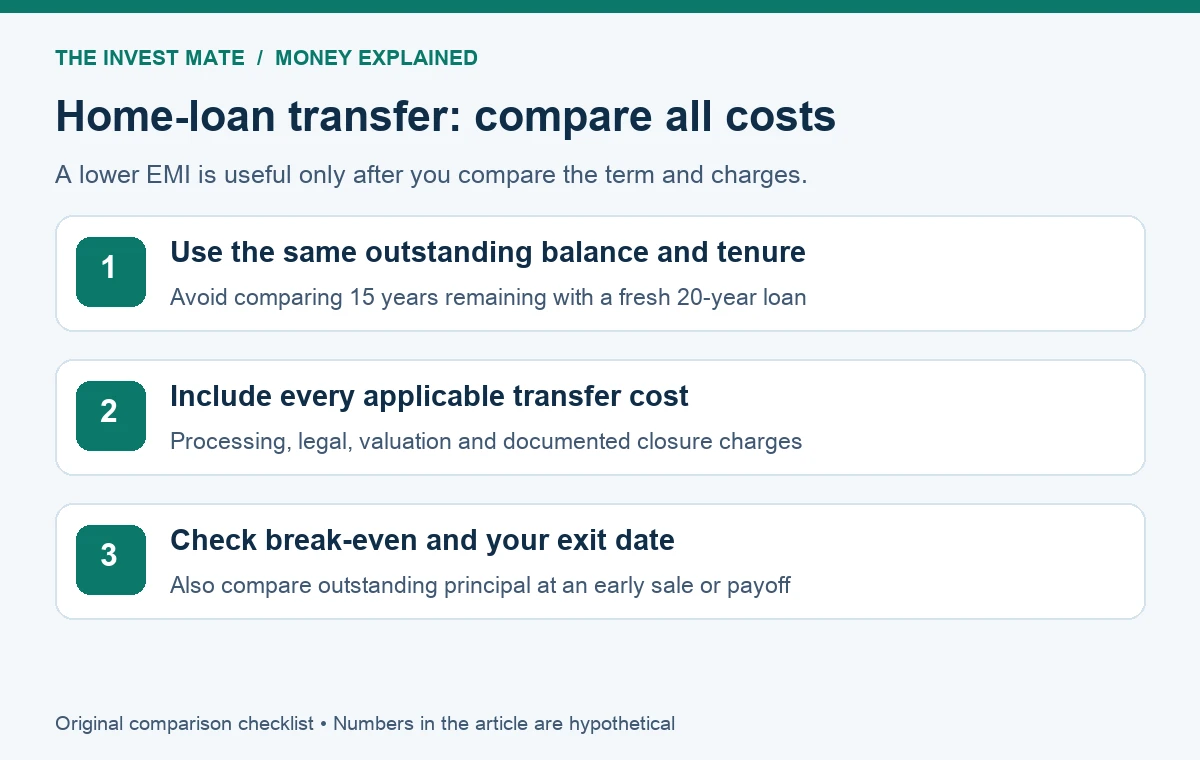
A home loan balance transfer can reduce your rate while still costing money upfront. Compare the same outstanding balance and remaining term, add the applicable fees, and check when the saving recovers those costs. A lower EMI on a much longer new loan does not prove that the transfer is cheaper.
- 1. Match balance and remaining term
Compare the same principal over the same horizon. - 2. Add the applicable fees
Use dated written quotes and include financed costs correctly. - 3. Compare break-even and your exit date
At an early exit, include the outstanding balance difference.
What is home-loan transfer break-even?
The simple cash-flow break-even is upfront transfer cost ÷ monthly EMI saving. It estimates how many monthly savings recover a cost paid separately at the start. The shortcut assumes the payment difference stays constant. It excludes the time value of money and, at an early exit, differences in outstanding principal.
If the monthly saving is zero or negative, this shortcut has no positive recovery period. If a lender adds fees to the new loan balance, recalculate the EMI on that higher balance rather than treating the fee as both an upfront cash cost and an additional loan amount.
Worked example: ₹30 lakh, 15 years remaining
Assume ₹30,00,000 outstanding, 180 month-end payments, an old rate of 9.00% and a proposed rate of 8.25%. Rates remain constant and the loan uses monthly reducing-balance interest. Assume a separate, all-inclusive ₹30,000 transfer cost. There are no missed payments, interim interest or prepayments in the model.
| Item | Keep current loan | Transfer |
|---|---|---|
| Principal | ₹30,00,000 | ₹30,00,000 |
| Remaining months | 180 | 180 |
| Assumed annual rate | 9.00% | 8.25% |
| Monthly EMI | ₹30,428.00 | ₹29,104.21 |
| Separate upfront cost | ₹0 | ₹30,000 |
The unrounded monthly saving is about ₹1,323.79. ₹30,000 divided by that saving gives 22.66 months. In this simplified cash-flow comparison, cumulative EMI savings first exceed the fee after the 23rd monthly payment. This is a model result, not a bank offer or a promise.
What happens if you keep the loan to its scheduled end?
Over 180 payments, the difference in total instalments is ₹238,281.62. Subtracting the ₹30,000 fee leaves approximately ₹208,281.62 of nominal modelled savings. Both balances reach zero at the same horizon, so comparing instalments plus the separate fee is consistent here.
A future floating-rate reset can change the outcome. Obtain the proposed benchmark, spread and reset frequency in writing. Our home-loan comparison calculator helps organise the two schedules; use the EMI calculator to reproduce each payment with your quoted inputs.
What if you sell or repay after two years?
At an early exit, compare the amount you still owe as well as the payments already made. In the same model, after 24 payments:
| Component | Keep current loan | Transfer |
|---|---|---|
| Payments made | ₹730,271.94 | ₹698,501.06 |
| Outstanding principal | ₹2,792,377.87 | ₹2,779,568.37 |
| Upfront cost | ₹0 | ₹30,000 |
The current-loan payments plus remaining balance, minus the transfer payments, remaining balance and fee, gives a modelled advantage of ₹14,580.38 for the transfer. This includes the balance difference; the simple EMI-only break-even does not. Obtain actual dated settlement amounts because real daily interest, taxes and applicable charges can change an early-exit comparison.
Which balance-transfer costs belong in the worksheet?
| Cost or condition | What to record |
|---|---|
| Processing fee | Amount, applicable tax, and refund terms |
| Legal and valuation | Whether charged separately and payable before approval |
| Documentation or security charges | Applicable local charges and who pays |
| Current lender settlement | Dated payoff amount and any legally applicable charge |
| Rate-switch alternative | Cost and terms of repricing with your present lender |
| Added borrowing | Any top-up or financed fee; compare separately |
Do not insert a foreclosure penalty merely because an online checklist lists it. Applicable RBI rules, the type and purpose of the loan, sanction or renewal date and contract terms matter. Ask the lender to identify the legal basis of any charge. RBI's floating-rate EMI reset FAQ explains repayment options and points to applicable prepayment instructions; it is not a fee quote for your account.
Why extending tenure can make a quote look cheaper
If the current loan has 15 years left and the replacement has 20 years, the new EMI spreads repayment across 60 additional months. First compare both at 15 years. Then show a second 20-year scenario separately, including its last payment date and total interest. A cash-flow benefit and a total-cost benefit answer different questions.
Also separate a top-up from a transfer. Adding ₹5 lakh of new borrowing changes the balance and purpose of the comparison. Identify the extra borrowing, rather than crediting its entire payment change to a lower rate.
Before accepting a new quote
- Use a recent statement with outstanding principal and remaining months.
- Get both quotes on the same comparison date.
- Check benchmark, spread, reset frequency and all conditions.
- Recalculate with fees and a realistic expected exit date.
- Ask for the final repayment and settlement schedule.
Read our repo-rate and home-loan reset guide for the current policy context, and the home-loan affordability checklist for the wider borrowing comparison.
Frequently asked questions
Is a 0.75-percentage-point lower rate enough to transfer?
The rate difference alone cannot answer that. Balance, term, fees, future resets and expected exit date determine the comparison.
Can I use the original loan amount?
Use the outstanding amount you would transfer now, not an old sanction amount that includes principal already repaid.
Is break-even the same as total interest saved?
No. Break-even describes recovering a cost over a period. Total interest saved compares entire repayment schedules under stated assumptions.
Method and sources
EMIs use P × r ÷ (1 − (1+r)^(-n)), where r is annual percentage rate divided by 1,200. Balances after m payments use P(1+r)^m − EMI((1+r)^m−1)/r. The figures are independently calculated educational examples, rounded for display. RBI's linked FAQ supports the discussion of reset options; no current lender rate or individual eligibility is asserted.