Policy decision: 7 October 2026. Sources checked: 7 October 2026.
In this guide
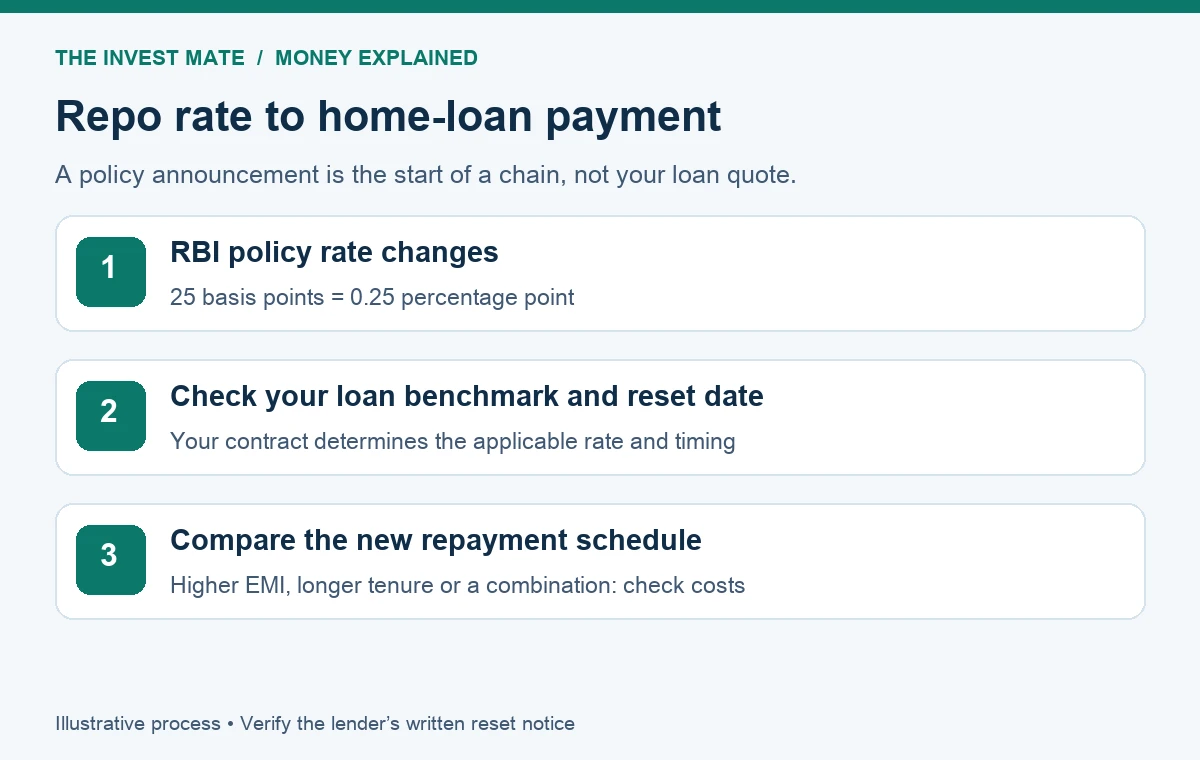
The RBI repo rate hike of 7 October 2026 takes the policy rate to 5.50%, an increase of 25 basis points. A higher repo rate does not mean every borrower's EMI rises on the announcement date. Your loan's benchmark, next reset date and revised repayment schedule determine the effect on you. RBI's October monetary-policy resolution is the source for the policy decision.
- 1. RBI policy rate changes
25 basis points = 0.25 percentage point. - 2. Your loan reaches its reset date
Check the benchmark, spread and new applicable rate. - 3. Your repayment schedule changes
Compare EMI, remaining term and total cost.
What is the current RBI repo rate?
As of the 7 October 2026 decision, the policy repo rate is 5.50%. The repo rate is a policy benchmark; it is not the rate written into every home-loan contract. A 25-basis-point change is 0.25 percentage point. In a simple illustration, an 8.50% loan rate becoming 8.75% is a 25-basis-point increase, not a 25% increase in the rate.
Will your home loan EMI increase immediately?
Read the benchmark and reset schedule on your loan statement. Ask your lender for the new applicable rate, when it begins and whether the lender proposes to change the EMI, the remaining tenure or both. For a fixed-rate contract, examine its actual terms rather than assuming a floating-rate reset applies. A news headline cannot supply these account-specific details.
RBI's FAQ on resetting floating-rate EMI loans describes options including a larger EMI, a longer term or a combination, switching rate type under the lender's policy, and part or full prepayment. Check the applicable conditions and charges before choosing. The FAQ covers EMI-based personal loans linked to internal or external benchmarks; this guide does not establish your individual eligibility.
₹25 lakh, ₹50 lakh and ₹75 lakh home-loan EMI examples
The examples below use outstanding principal, 240 remaining monthly instalments and a hypothetical loan-rate change from 8.50% to 8.75%. They assume the new rate stays constant for the remaining term, payments occur at month-end and there are no fees, arrears or prepayments. These are not bank offers or a prediction of your reset.
| Outstanding | EMI at 8.50% | EMI at 8.75% | Monthly increase |
|---|---|---|---|
| ₹25 lakh | ₹21,695.58 | ₹22,092.77 | ₹397.19 |
| ₹50 lakh | ₹43,391.16 | ₹44,185.54 | ₹794.37 |
| ₹75 lakh | ₹65,086.74 | ₹66,278.30 | ₹1,191.56 |
Each increase is calculated from unrounded figures and then rounded independently, so subtracting the two displayed EMI values can differ by one paisa. Use our EMI calculator with your own balance, remaining months and rate. For two quotes or a transfer scenario, the home-loan comparison calculator keeps the assumptions separate.
How the EMI calculation works
For principal P, monthly interest rate r and remaining months n, the reducing-balance formula is EMI = P × r / (1 − (1 + r)^(-n)). Convert an annual percentage rate to r by dividing it by 1,200. At zero interest, EMI is simply principal divided by months. A real lender can use different dates and rounding conventions.
Use today's outstanding balance, not the original amount borrowed years ago. Likewise, enter remaining tenure rather than restarting the original 20- or 25-year term. Mixing an old principal with a new rate exaggerates or misstates the effect of a reset.
What if the bank keeps the EMI unchanged?
In the ₹50 lakh example, holding the old ₹43,391.16 payment at 8.75% gives a simplified payoff estimate of approximately 252.43 months, instead of 240. A monthly payment schedule would therefore extend into a 253rd payment, with a smaller final payment in this model. This is an illustration of the trade-off, not a lender-approved schedule.
The same monthly bill can hide a longer repayment commitment. Ask for the revised amortisation schedule and compare both the remaining interest and the last-payment date. A smaller payment is not automatically the cheaper option.
| Choice | Monthly payment | Modelled remaining term |
|---|---|---|
| Keep 240 months | ₹44,185.54 | 240 months |
| Keep old payment | ₹43,391.16 | About 252.43 months; smaller final payment |
What to check before a balance transfer or prepayment
- Record the outstanding principal and current reset terms in writing.
- Get a dated quote with the proposed rate, spread, reset frequency and charges.
- Compare total cash outflow over the same remaining horizon. Include transfer, processing and other applicable costs.
- Check how a part prepayment changes the repayment schedule and what cash remains accessible for other bills.
- Ask the lender to confirm the final schedule before treating an online estimate as an agreed outcome.
Our home-loan fee and affordability checklist helps organise this comparison. A rate difference alone is not enough to decide whether transferring is worthwhile.
Will FD interest rates increase after the repo rate hike?
Do not add 0.25 percentage point to every advertised deposit rate. Check each bank's current rate card, deposit date, term and product conditions. Distinguish the terms of an existing deposit from a new offer. See our dated FD comparison guide and official bank links before using a quote.
Frequently asked questions
Is the repo rate my home-loan interest rate?
No. Use the account's actual applicable rate and benchmark terms. The policy rate alone does not determine your payment.
Does a 25-basis-point hike mean EMI rises by 0.25%?
No. EMI depends on the balance, rate and remaining term through the amortisation formula. The worked examples show a different percentage change in the monthly payment.
Should I increase EMI or extend tenure?
Compare the cash-flow requirement and remaining cost under each available option. This article does not choose an option for your circumstances.
For a full cost worksheet, read our home-loan balance-transfer break-even guide.
Sources and calculation note
Policy facts: RBI's 7 October 2026 resolution. Reset options: RBI's published floating-rate EMI-loan FAQ. EMI and tenure examples are independently calculated educational illustrations. Rates used in examples are assumptions, not current loan offers. Reviewed 7 October 2026.