Guide reviewed 10 October 2026; quote calculator added 19 October 2026. This guide uses assumed prices to explain a jewellery bill. It does not publish a live gold rate or predict gold returns.
Before buying gold jewellery, compare its net metal weight, purity, making charges, taxes and written resale terms. A low headline gold rate or a “making charge discount” is only one part of the purchase. Match the full itemised quote with the piece you are actually buying.
If you are shopping for a wedding, Dhanteras or a gift, decide the purpose and maximum total budget first. Jewellery and an investment product solve different needs. For investment choices, read our gold investment guide; this page focuses on checking a physical jewellery purchase.
Gold making charges calculator: compare two jewellery quotes
Enter the same net gold weight and purity for both offers, then each seller’s own quoted rate. Choose making charges as a percentage of metal value or rupees per gram. Open “Discount & other charges” when those apply. The result separates the metal cost, payable making charge, tax and final bill.
Use the 10-gram worked example below if the interactive comparison is unavailable.
How the comparison is calculated
- Metal value: net gold weight × that quote’s price per gram for the selected purity.
- Making charge: metal value × percentage ÷ 100, or net gold weight × rupees per gram.
- Discount: applied to the making charge alone, before GST. A 50% making discount does not halve the whole bill.
- Final bill: metal value + discounted making + other included sale charges, then GST on that subtotal.
With the sample inputs, Quote A’s 8% making charge gives a ₹1,00,116 total; Quote B’s ₹600-per-gram charge gives ₹98,880. The ₹1,236 difference includes the resulting tax difference. Both use a hypothetical ₹9,000/g rate, 10 grams and 3% GST, with no extra charges. These are reproducible examples, not current gold prices.
The default tax input follows CBIC’s retail-jewellery FAQ; check the applicable treatment on your dated invoice. This comparison is for plain retail jewellery, not a separate repair/job-work service, stone valuation or old-gold exchange. It does not convert a 24K rate into a 22K rate or decide which design is better.
22K vs 24K gold: read the fineness marking
BIS lists 22K916, 18K750 and 24KS995 among the permitted jewellery/artefact hallmark grades. Its HUID-era hallmark has three components: the BIS logo, purity in caratage and fineness, and a six-character alphanumeric HUID. Source: BIS hallmarking FAQs.
| Marking | Fineness represented | Comparison to make |
|---|---|---|
| 18K750 | 750 parts gold per thousand | Compare with another 18K750 item of similar net weight |
| 22K916 | 916 parts gold per thousand | Use the quoted 22K rate, not a different-purity headline |
| 24KS995 | 995 parts gold per thousand | Read the exact marking; do not treat every “24K” label as identical |
The fineness number helps explain the metal content. In a simplified calculation, 10 grams marked 916 represents approximately 9.16 grams of gold content, whereas 10 grams marked 750 represents 7.50 grams. Those calculations do not value the design, stones or workmanship, and they are not a promise of the amount a buyer will pay on resale.
A higher purity number alone does not tell you which piece suits your intended wear. Ask the jeweller about the particular design, repairs and care, then compare pieces with the same stated purity. Do not compare an 18K studded item with a plain 22K chain using gross weight alone.
How to verify HUID before buying gold jewellery
Use the official BIS Care app and its Verify HUID feature. Read the code from the actual item, enter it carefully and compare the result with the piece and seller's explanation. If it fails or appears inconsistent, resolve the discrepancy before paying.
- Ask to see the marks on the piece, using magnification if needed.
- Write down the HUID from the item rather than accepting an unrelated screenshot.
- Open Verify HUID in the official BIS Care app and check the returned record.
- Keep the bill and a clear record of the item and its marks for future reference.
BIS's jeweller FAQs say the invoice should identify each article, net precious-metal weight, purity and hallmarking charges; they currently describe printing HUID on the invoice as voluntary. You can still request it for your records. Source: BIS jeweller FAQs.
HUID verification addresses the hallmark record. It does not by itself establish that a selling price is competitive or that a store will refund making charges on resale. Check the commercial terms separately.
Gold jewellery bill calculation: a 10-gram example
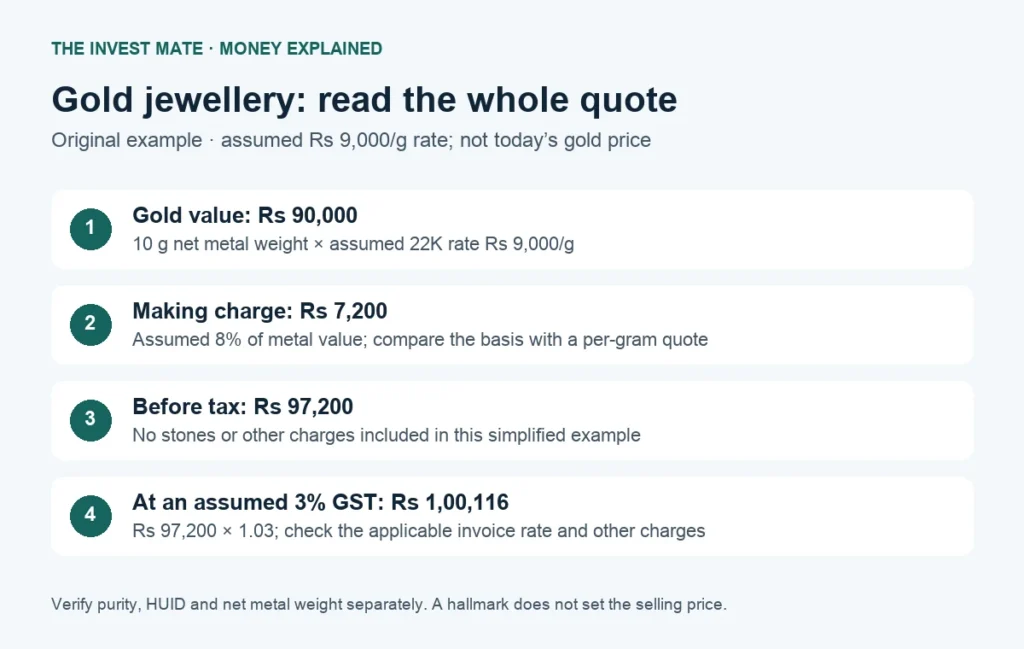
Assume a plain item has 10 grams net gold weight, a quoted 22K rate of ₹9,000 per gram and making charges of 8% of metal value. There are no stones, wastage additions or separately charged items in this example. The ₹9,000 rate is invented for reproducible arithmetic, not today's gold price.
| Component | Calculation | Amount |
|---|---|---|
| Metal value | 10 g × ₹9,000/g | ₹90,000 |
| Making charges | ₹90,000 × 8% | ₹7,200 |
| Pre-tax value | ₹90,000 + ₹7,200 | ₹97,200 |
| GST at assumed 3% | ₹97,200 × 3% | ₹2,916 |
| Illustrative total | ₹97,200 + ₹2,916 | ₹1,00,116 |
CBIC's sectoral FAQ describes 3% GST on the total transaction value of a retail jewellery supply, even when making charges are shown separately. It distinguishes that from registered job-work charges. Check the applicable notification and your actual invoice for the transaction date, especially after a new tax announcement. Source: CBIC sectoral FAQ, gems and jewellery.
Net weight × matching-purity rate → metal value → making and other charges → applicable tax → total bill
Percentage vs per-gram making charges
Convert both methods to rupees before comparing. At our assumed ₹90,000 metal value, an 8% making charge is ₹7,200. A ₹600-per-gram charge on the same 10-gram item is ₹6,000. The difference is ₹1,200 before tax, provided the seller applies that per-gram basis to the same net weight and includes the same work.
Also ask what “50% off making charges” starts from. A discount on a larger base can still leave a higher payable charge. In our example, 50% off an original 16% making charge becomes 8%, or ₹7,200. A different jeweller's 7% charge without a discount becomes ₹6,300. Compare payable amounts instead of the size of the advertised discount.
How to compare two gold jewellery quotes fairly
| Check | Quote A | Quote B |
|---|---|---|
| Purity and net metal weight | Write the actual marking and grams | Match them before comparing |
| Rate per gram | Record purity, date and quoted rate | Use the same date where possible |
| Making charge in rupees | Convert any percentage or per-gram basis | Check which weight/value is used |
| Stones and other additions | List their prices separately | Check what is included or excluded |
| Tax and final payable amount | Request an itemised written bill | Compare the complete amount |
| Exchange or buyback | Request written deductions and conditions | Check same-store versus outside-store treatment |
Do not treat the total gross weight of a studded piece as net gold weight. For a hypothetical 12-gram item with 2 grams of non-gold components, the 10-gram metal basis matters to the quote. Ask the seller to identify the actual components instead of estimating them from appearance.
Resale and exchange: ask for a written calculation
Keep a purchase bill and request the store's current written exchange or buyback policy. Ask which value is used, what deductions apply and how stones or other components are treated. A purchase price of ₹1,00,116 in our example does not establish a guaranteed future resale amount.
If your main purpose is saving for a future purchase, separate that goal from today's sale urgency. The RD calculator can illustrate regular saving, using your own quoted deposit rate. It does not predict the gold price at your future shopping date.
Frequently asked questions
Will the gold making charges calculator fetch today’s gold price?
No. Enter each jeweller’s dated rate for the purity you are actually comparing. Selecting 22K916 labels the comparison; it does not automatically convert a different-purity quote.
Why might the calculator differ from my jewellery invoice?
Check the net metal weight, rate basis, discount, extra charges and tax treatment line by line. The tool keeps full precision internally and displays two decimals; the seller may round differently. Stone charges, an exchange credit or a separate service invoice need their own breakdown.
Is 916 gold the same marking as 22K?
22K916 is one of the grades listed by BIS. Read both the caratage and fineness on the specific piece and verify its HUID record.
Are making charges included in the advertised gold rate?
Ask for a complete quote. Our illustration keeps metal value and making charges separate so the amount can be checked; actual offers may present their prices differently.
Can I assume 5% GST separately on retail making charges?
Do not mix the retail jewellery supply explanation with the separate job-work example in CBIC's FAQ. Match the invoice treatment to the actual transaction and applicable rules.
Does a hallmark guarantee a good resale price?
It addresses purity/fineness. Resale also depends on the buyer's valuation and commercial terms. Request those terms in writing.
Is the ₹9,000 rate in this guide today's price?
No. It is an assumed input used in the calculation. Obtain a dated local quote for the exact purity you intend to buy.
Sources and scope: BIS hallmarking FAQs, BIS jeweller FAQs, BIS Care app information and CBIC's sectoral FAQ are linked above. Arithmetic, diagrams and comparison worksheets are original. This guide is not a gold-price forecast or a recommendation to borrow to buy jewellery.