Reviewed 10 October 2026. Examples below are original illustrations, not live Amazon, Flipkart or bank offers.
No-cost EMI can spread a purchase across instalments, but you should compare the total amount paid with the best eligible full-payment price. A merchant may offset bank interest while processing fees, taxes or different discount conditions still change the bill. A small monthly payment does not establish a cheaper purchase.
During festive shopping sales, compare payment options for the exact same phone, laptop or appliance. Keep the seller, warranty, delivery charges and eligibility constant. This guide explains the calculation rather than promising that any particular sale or credit card is cheapest.
How does no-cost EMI work?
One common structure combines a merchant discount or cashback with interest charged by the lender. HDFC Bank's EasyEMI terms describe this arrangement for online no-cost EMI and separately list GST on EMI interest, processing fees, reward exclusions and preclosure conditions. Source: HDFC Bank EasyEMI terms.
Flipkart's EMI terms also say the issuing bank may charge processing fees and applicable GST, and direct customers to check how refunds or preclosure affect the loan. These are provider-specific terms, not a promise that all EMI offers have identical costs. Source: Flipkart EMI terms.
Separate three numbers: the product's eligible price, the amount financed, and everything paid across the repayment schedule. If the checkout discount is intended to offset interest, do not subtract it a second time when comparing the final bill.
A ₹30,000 no-cost EMI example with fees and GST
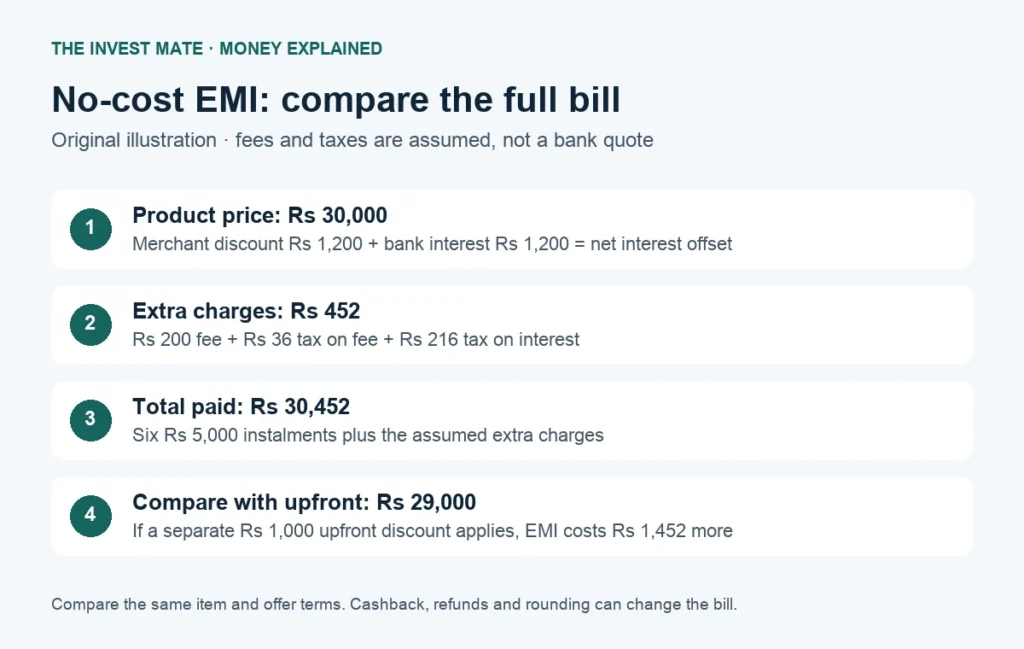
Assume an item costs ₹30,000. The merchant gives a ₹1,200 upfront EMI discount, leaving ₹28,800 financed. The bank's quoted schedule adds ₹1,200 total interest over six instalments. Each instalment is ₹5,000 before separate charges. Assume a ₹200 processing fee, 18% tax on that fee and 18% tax on the interest for this example.
| Component | Amount | How it enters the comparison |
|---|---|---|
| Product price | ₹30,000 | Starting price under this EMI offer |
| Upfront merchant discount | −₹1,200 | Financed amount becomes ₹28,800 |
| Total bank interest | +₹1,200 | Assumed to offset that discount exactly |
| Processing fee | +₹200 | Assumed charge; use your actual quote |
| Tax on fee at assumed 18% | +₹36 | ₹200 × 18% |
| Tax on interest at assumed 18% | +₹216 | ₹1,200 × 18% |
| Total paid | ₹30,452 | Six instalments plus ₹452 assumed extras |
₹30,000 item → ₹28,800 financed → ₹30,000 instalments → ₹30,452 with assumed extras
The ₹1,200 interest here is a supplied example total, not calculated from an advertised annual rate. For a real purchase, use the lender's complete repayment schedule. Do not assume “annual rate × original price × months” correctly models a reducing-balance loan.
No-cost EMI vs full payment: which costs less?
Now assume the same item has a different full-payment offer of ₹1,000 off. Its upfront price becomes ₹29,000. Compared with our ₹30,452 EMI example, the difference is ₹1,452. That comparison is valid only if you qualify for both offers and the same item is available on the same terms.
| Scenario | Upfront total | EMI total | Difference |
|---|---|---|---|
| No separate upfront discount | ₹30,000 | ₹30,452 | EMI costs ₹452 more |
| ₹1,000 upfront-only discount | ₹29,000 | ₹30,452 | EMI costs ₹1,452 more |
| Assumed ₹600 qualifying EMI-only cashback actually received | ₹30,000 | ₹29,852 net | EMI costs ₹148 less |
Cashback in the last row is an assumption. If it is capped, delayed, conditional or lost after a return, the result changes. Keep an initial cash-outflow comparison separate from a comparison after confirmed cashback. Do not count an expected reward as money already received.
What to check before buying on EMI
- Capture both eligible prices: save the final full-payment and EMI checkout summaries after entering the relevant card and tenure.
- Read the repayment schedule: write down all instalments, processing charges, taxes and any upfront payment.
- Check the discount route: distinguish an immediate discount from a cashback credit that depends on later conditions.
- Check offer compatibility: verify whether exchange benefits, coupons, card discounts and rewards can actually combine.
- Check monthly affordability: add the new EMI to existing commitments, rather than judging it in isolation.
- Save the terms: retain the order summary and lender confirmation so a statement discrepancy can be checked.
For a simple cash-flow check, suppose your monthly take-home is ₹50,000 and your planned essentials, existing repayments and saving total ₹44,000. A ₹5,000 EMI leaves ₹1,000 unallocated. That does not mean the purchase fits comfortably: an irregular medical, repair or travel bill can consume the remaining amount. Use your actual expenses and keep an emergency buffer.
Our emergency fund guide helps separate planned purchases from reserves. A lender's approval is not a household budget.
Also separate an EMI instalment from the minimum amount printed on a credit-card statement. Our credit card minimum due vs total due guide explains the difference and compares fixed repayment amounts on an illustrative ₹30,000 balance.
What happens if you return the product or close EMI early?
Check the merchant refund and the lender's loan status separately. Save the refund reference, then verify the next card statement or repayment schedule. If the loan remains active, use the lender's official support channel to resolve it before assuming future instalments have stopped.
Do not plan a purchase around keeping an EMI discount after immediate foreclosure. Ask for a written settlement quote covering the outstanding amount, charges and treatment of discounts. Refund processing and loan closure can have different timelines.
For a cancelled shopping order, our credit-card EMI refund and closure checklist compares issuer rules, partial refunds, retained charges and the statement details to confirm with the bank.
Frequently asked questions
Is no-cost EMI completely free?
Compare the final repayment schedule with the best full-payment offer you qualify for. Interest offset alone does not answer whether fees, taxes or different discounts change your total.
Why is interest shown on my no-cost EMI statement?
A merchant benefit and bank interest can be separate entries. Match the checkout benefit against the full schedule. If they do not reconcile, ask the merchant and lender to explain the specific transaction.
Does every bank charge the same processing fee?
No. Use the fee in your actual lender and product terms. The ₹200 in this article is a calculation assumption.
Is ordinary EMI conversion after shopping the same offer?
Do not assume it is. A later conversion has its own quotation; check whether the original merchant benefit applies before accepting it.
Should I borrow to keep my savings invested?
Compare certain borrowing costs with uncertain investment outcomes and your liquidity needs. A projected return is not a guaranteed offset to a payment obligation.
Sources and scope: HDFC Bank EasyEMI and Flipkart EMI terms linked above were reviewed on 10 October 2026. The tables, flow diagram and budget examples are original illustrations. Offer availability and your statement terms determine the actual bill.