Reviewed 10 October 2026. This guide compares recurring-deposit terms and shows original calculation examples. The example rates are assumptions, not live offers.
Post Office RD vs bank RD comes down to your saving period, installment rules and access needs, as well as the quoted interest rate. A standard Post Office RD has a five-year maturity; bank terms depend on the product. Compare the same monthly deposit over the same period, then check what happens if you miss a payment or need to close early.
Use our recurring deposit calculator for an illustration and the provider's written schedule for the actual payout. An estimated maturity amount alone cannot tell you which account fits your cash flow.
Post Office RD and bank RD: the main differences
The National Savings Institute describes the Post Office RD as a five-year scheme with a minimum ₹100 monthly deposit, in multiples of ₹10. Its overview says premature closure is available after three years with the Post Office Savings Account interest treatment. Check the scheme rules and account office before assuming the full-term RD interest applies to an early closure. Source: National Savings Institute RD overview.
SBI's standard recurring-deposit page lists a 12–120 month term and a minimum ₹100 monthly installment, followed by multiples of ₹10. It also describes charges for delayed installments and premature withdrawal. Other banks have their own terms; the label “bank RD” does not mean one universal product. Source: SBI recurring deposit.
| Question | Post Office RD | Bank RD |
|---|---|---|
| What is the standard term? | Five years for the National Savings RD scheme | Provider-specific; SBI's standard product lists 12–120 months |
| Which rate goes in the calculator? | The rate applicable to your account opening and scheme | The quote for your opening date, tenure and customer category |
| What if a payment is late? | Check scheme default and revival rules | Check charges, interest dates and default treatment |
| What if money is needed early? | Check the scheme's closure conditions and resulting interest | Request the early-closure payout for your planned date |
| How do I verify maturity? | Account office's applicable repayment schedule | Bank confirmation advice and actual installment dates |
₹1,000, ₹2,000 or ₹5,000 monthly: what changes?
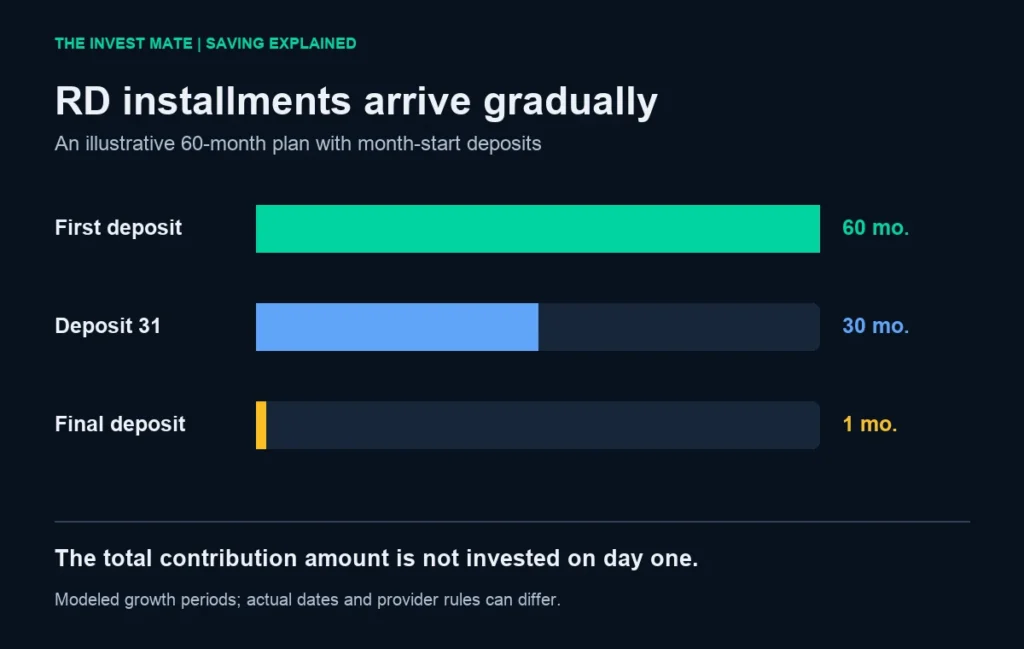
First separate your own contributions from interest. A ₹1,000 monthly deposit over 60 months contributes ₹60,000; ₹2,000 contributes ₹1,20,000; ₹5,000 contributes ₹3,00,000. You do not have that entire amount invested at the beginning.
The following table uses our calculator's regular month-start deposits and an illustrative 7% annual rate converted from quarterly growth to an equivalent monthly factor. It assumes all installments arrive on time, with no withholding or penalties. It is not an official Post Office or bank maturity table.
| Monthly deposit | Number of deposits | Your contributions | Modeled interest | Estimated maturity |
|---|---|---|---|---|
| ₹1,000 | 60 | ₹60,000 | ₹11,933 | ₹71,933 |
| ₹2,000 | 60 | ₹1,20,000 | ₹23,866 | ₹1,43,866 |
| ₹5,000 | 60 | ₹3,00,000 | ₹59,664 | ₹3,59,664 |
At the same rate and schedule, doubling the installment doubles the modeled maturity. It also doubles the monthly commitment. Check your monthly budget before choosing the bigger figure: a sustainable payment is more useful than a projection built on installments you cannot maintain.
Why RD interest is different from lump-sum FD interest
Arrives near the beginning of the saving plan.
Each arrives later and has less time to earn interest.
Arrives near maturity, so has little remaining growth time.
For our monthly model, let P be the deposit, N the number of months and r the annual rate as a percentage. The monthly growth factor is g = (1 + r / 400)^(1/3). Month-start maturity is P × g × (g^N − 1) / (g − 1); at zero interest it is simply P × N.
This is a regular cash-flow model. It spreads quarterly growth smoothly through modeled months. A provider may instead use actual dates, partial periods, rounding and scheme-specific repayment rules. HDFC Bank, for example, describes actual/actual quarterly compounding from the installment payment date, and says delayed payments can change maturity. Source: HDFC Bank RD details.
How to compare two RD quotes fairly
- Match the saving goal: write down the date you need the money. Compare an account term that fits that date.
- Match the installment: use the same monthly amount for both quotes. Keep any different minimum-payment requirement visible.
- Record the applicable rate: save the dated quotation and the customer category, rather than relying on an undated headline.
- Request maturity and early-exit amounts: ask how the payout changes if you close at your likely access date.
- Check the debit schedule: choose a payment date your cash flow supports and ask what a missed installment changes.
- Compare actual proceeds: keep deductions, withholding and charges separate from the gross maturity illustration.
Suppose your goal is three years away. A five-year projection may show a larger amount simply because it includes another two years of deposits and growth. That does not establish a better outcome for your three-year goal. Compare the money available at the date you actually need it.
Deposit insurance: keep all your bank balances in view
DICGC covers eligible deposits, including RDs, up to ₹5 lakh for principal and interest combined per depositor per insured bank in the same right and capacity. Separate accounts and branches at the same bank do not automatically create separate coverage. Source: DICGC FAQs.
For example, ₹3 lakh in savings plus ₹2.5 lakh in an RD at the same insured bank in the same capacity already exceeds ₹5 lakh before adding accrued interest. Keep a complete deposit inventory rather than checking the RD balance alone. This bank-insurance framework should not be used as a description of the Post Office scheme.
Frequently asked questions
Is Post Office RD always better than SBI or another bank RD?
There is no universal winner. Compare your goal date, sustainable installment, applicable quote, access conditions and payment convenience. A higher headline rate does not settle those questions.
Can I use a generic RD calculator for a Post Office account?
Use it as an illustration with the appropriate term and quoted rate. Confirm the final amount using the account office's applicable schedule; the tool does not model every scheme rebate, default or extension rule.
Is the calculator's 7% example the current Post Office RD interest rate?
No. It is a calculation assumption used to make the examples reproducible. Obtain the applicable account-opening quote before estimating a real account.
Does a longer tenure always make an RD better?
It can increase the projected maturity while requiring more installments and a longer commitment. Compare the payout and access conditions at your actual goal date.
Next steps and sources
Try the RD calculator and downloadable monthly schedule. If you already have a lump sum, use the FD maturity calculator to compare the different cash flow. Our dated FD comparison guide explains how to check a bank offer.
Product references: National Savings Institute RD overview, SBI RD page, HDFC Bank RD details and DICGC FAQs linked above. Examples, formulas, diagram and decision checklist are original educational explanations. Sources and arithmetic reviewed 10 October 2026; verify account-specific terms before opening or closing a deposit.