Effective date in the government announcement: 17 September 2026. Sources reviewed: 7 October 2026.
In this guide
The EPFO wage ceiling for mandatory coverage increased from ₹15,000 to ₹25,000 a month, according to the Ministry of Labour & Employment's 16 September 2026 announcement. The Employees' Provident Fund Organisation is often searched simply as EPFO. For an employee reviewing an October payslip, the practical question is which wage base and contribution rate payroll has applied—not whether every ₹25,000 gross salary has the same deduction.
What is the new EPFO wage ceiling?
The announced ceiling is ₹25,000 per month, with effect from 17 September 2026. The government describes the change as expanding mandatory coverage and access to EPF, pension and insurance protection. Coverage still needs to be checked under the applicable statutory provisions and scheme rules; this short guide does not determine anyone's membership status.
A coverage threshold, PF wage base, employee contribution and take-home salary are different figures. Keep them separate when reading a headline. CTC also includes components that need not all arrive as cash in your bank account.
How much PF is deducted from a ₹20,000 or ₹25,000 wage base?
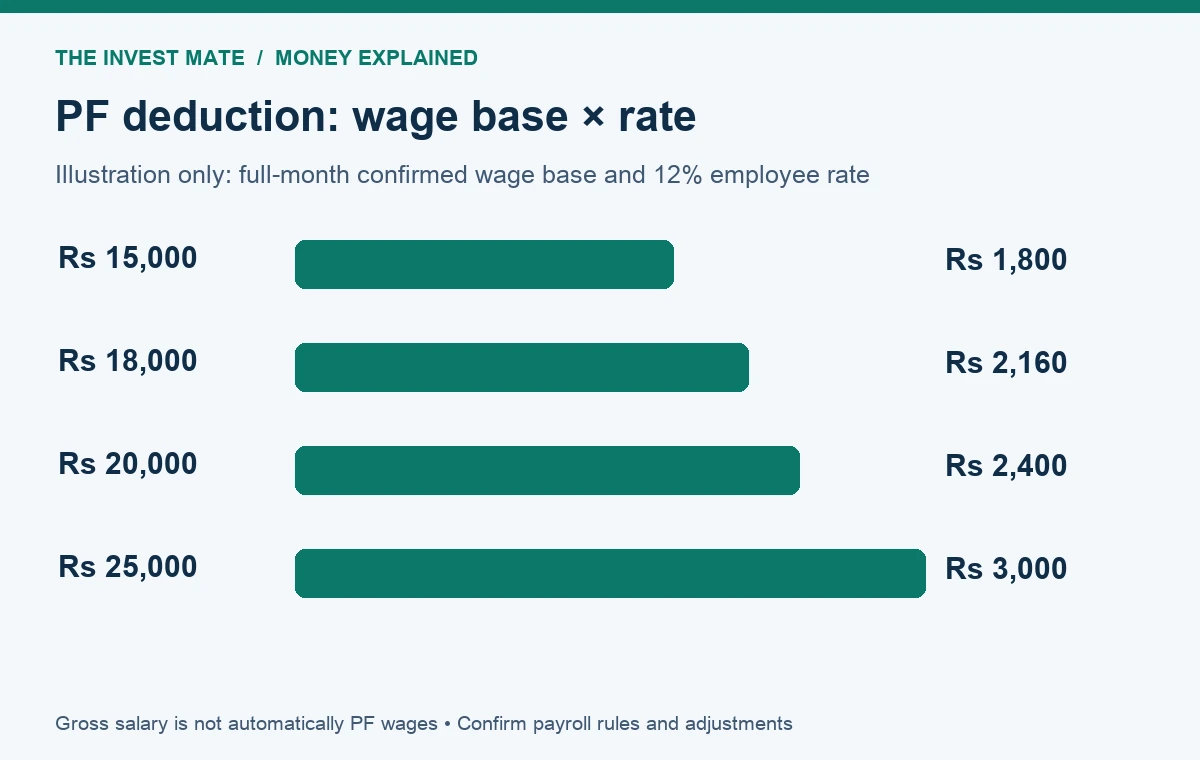
For illustration, assume payroll has confirmed a full month's applicable PF wage base and a 12% employee contribution rate. The arithmetic is employee contribution = confirmed PF wage base × 12%. EPFO's contribution-rate document also identifies 10% and 12% categories. That older document contains the previous ceiling, so do not use its historical ₹15,000 figure in place of the newer government announcement.
| Confirmed PF wage base | Calculation | Employee contribution |
|---|---|---|
| ₹15,000 | ₹15,000 × 12% | ₹1,800 |
| ₹18,000 | ₹18,000 × 12% | ₹2,160 |
| ₹20,000 | ₹20,000 × 12% | ₹2,400 |
| ₹25,000 | ₹25,000 × 12% | ₹3,000 |
These examples are not a declaration that every person with that gross salary has that PF wage base or rate. An employee already contributing on a different eligible basis should ask payroll which basis remains applicable. Use the actual payslip and membership record to check your case.
Why people mention a ₹1,200 take-home difference
If your employee contribution actually changes from ₹1,800 to ₹3,000, the additional deduction is ₹1,200 a month. If every other cash item is unchanged, that is ₹1,200 less cash available in the monthly payroll illustration. It is not a universal pay cut or a complete tax-and-salary calculation.
Compare two complete payslips. Tax withholding, benefits, reimbursements, arrears, voluntary contributions and other deductions may also change. A difference in your bank credit cannot be attributed entirely to PF without checking the lines that produced it. Do not assume an employer contribution is a second identical deduction from your cash salary.
Five items to ask payroll to confirm
- Membership and coverage: what scheme rules apply to your employment and membership history?
- Wage base: which components and amount have been treated as PF wages?
- Employee rate: which statutory rate and any voluntary contribution apply?
- Employer allocation: what amounts were reported to EPF, EPS and any other applicable scheme?
- Wage month: is a line a normal full-month amount, an adjustment or a separate prior-period entry?
Ask for the calculation in writing. If the wage base is ₹20,000 and payroll confirms a 12% employee contribution, ₹2,400 follows directly from arithmetic. If the deduction is different, compare the confirmed basis and any separately identified adjustment before alleging an error.
Why September and October payslips may need different checks
The announced effective date falls inside September. A full-month illustration above does not calculate a September transition or establish how a specific adjustment should be handled. Ask payroll for the applicable official implementation instructions and a dated breakdown of any transition-period amount. Do not apply a full-month ₹3,000 figure to every September record just because the headline mentions a new ceiling.
Keep the wage month separate from the date a deduction appears in a payslip or a contribution appears in a statement. This makes it easier to explain what you are comparing when you raise a query.
Use the calculator without overstating your EPF balance
Our EPF calculator accepts an editable wage base and actual employer EPF credit. Use payroll-confirmed values. Do not add the entire employer payment to an EPF projection when part is reported to pension or another component; verify the allocation rather than assuming a split from an old example.
The CTC-to-in-hand calculator is a separate illustration with a stated tax-year basis. For an October cash-flow adjustment, our monthly budget planner can use your actual current take-home and bills without predicting the payroll result.
Next, use our EPF passbook guide to separate employee, employer EPF and pension entries.
Frequently asked questions
Does ₹25,000 gross salary always mean ₹3,000 PF deduction?
No automatic inference should be made. Confirm the applicable PF wage base, contribution rate, membership and any adjustment.
Will everyone lose ₹1,200 of take-home salary?
No. That difference belongs only to the illustrated change from ₹1,800 to ₹3,000, with other payroll cash items unchanged.
Can I use an old contribution PDF as the current ceiling rule?
Read its date and scope. The older rate document should be read alongside the newer wage-ceiling announcement and applicable implementation instructions.
Sources and scope
Coverage ceiling and commencement date: Ministry of Labour & Employment announcement of 16 September 2026. Rate categories: EPFO contribution-rate document. The rupee examples and payslip checklist are original educational illustrations. Sources reviewed 7 October 2026; this article does not provide a personal payroll or legal determination.