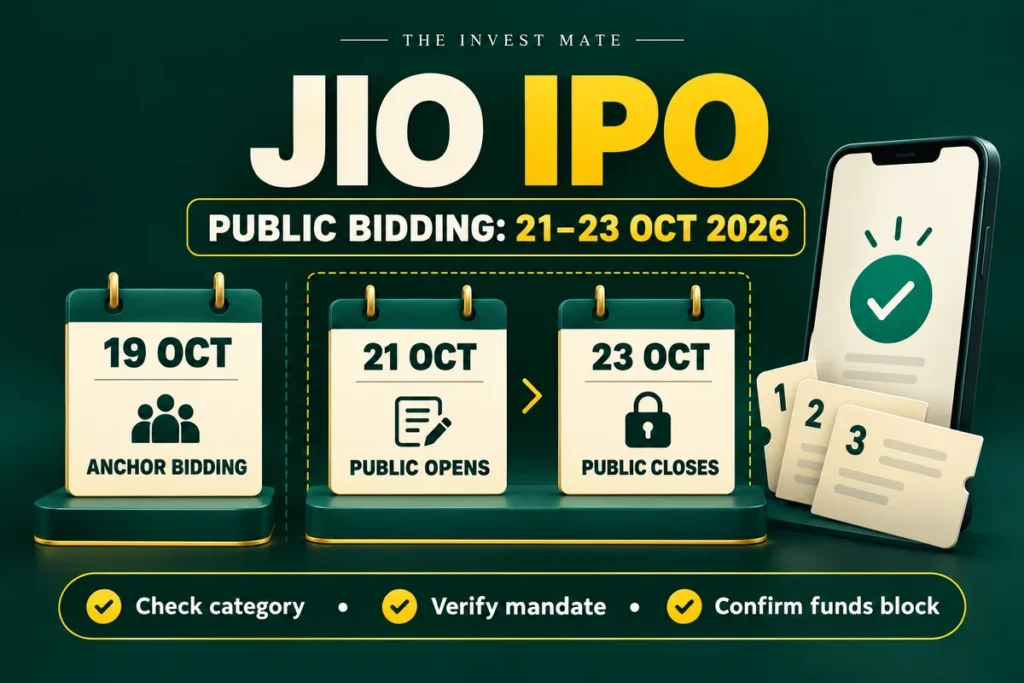
Jio IPO quick answer, checked 17 October 2026: Jio Platforms' public bidding window is 21–23 October 2026. The announced price band is ₹1,065–₹1,119 per share, with 12 shares per lot. One lot therefore costs ₹12,780 at the lower price or ₹13,428 at the upper price. The latter is the amount to budget for a one-lot bid at the cap price, before considering your personal cash needs.
This guide separates the official issue details from application arithmetic and unanswered market speculation. It does not recommend applying or predict a listing gain. The sources are the SEBI RHP filing and Reliance's 14 October price-band announcement.
The SEBI-hosted abridged prospectus schedules anchor bidding for 19 October and public bidding for 21–23 October 2026. The anchor date does not open the public application window. If your broker accepts a request beforehand, check whether it is an advance request or an accepted exchange bid.
What should a retail applicant check before 21 October?
Keep three records separate: your application, the payment mandate and the bank’s funds block. An advance request, an accepted bid and an allotment are separate stages.
- Before submitting: compare the company name, eligible category, share quantity and bid amount with the current official issue entry.
- After a mandate appears: read the company and amount before authorising it through your own bank or supported app.
- After authorisation: check the actual bank block and retain the application reference. For a missing request, use our IPO UPI mandate troubleshooting guide.
Jio IPO dates: opening, closing, allotment and listing
| Milestone | Date and meaning |
|---|---|
| Public bidding opens | 21 October 2026 Start of the public application window |
| Public bidding closes | 23 October 2026 Check your intermediary's submission deadline |
| Basis of allotment | On or about 26 October Planned allocation milestone |
| ASBA unblocking / share credit | On or about 27 October Different from an instant refund promise |
| Trading begins | On or about 28 October Indicative listing date, subject to approvals |
The RHP's issue programme states a 7 p.m. IST UPI mandate deadline on 23 October. A broker or bank can stop accepting submissions earlier. Do not assume a generic deadline from another IPO applies here. Source: RHP, Issue Procedure timetable, page 524.
Jio IPO lot size and minimum investment: the actual calculation
The price announcement confirms 12 shares and subsequent multiples of 12. The ₹54 employee discount applies to eligible employee-reservation bids; it is not a discount for every retail applicant or Reliance shareholder.
| Lots and shares | Bid amount at each price |
|---|---|
| 1 lot 12 shares | At ₹1,065: ₹12,780 At ₹1,119: ₹13,428 |
| 2 lots 24 shares | At ₹1,065: ₹25,560 At ₹1,119: ₹26,856 |
| 5 lots 60 shares | At ₹1,065: ₹63,900 At ₹1,119: ₹67,140 |
| 10 lots 120 shares | At ₹1,065: ₹1,27,800 At ₹1,119: ₹1,34,280 |
| 14 lots 168 shares | At ₹1,065: ₹1,78,920 At ₹1,119: ₹1,87,992 |
| 15 lots 180 shares | At ₹1,065: ₹1,91,700 At ₹1,119: ₹2,01,420 |
Formula: lots × 12 × selected bid price. For example, two lots at the cap price are 2 × 12 × ₹1,119 = ₹26,856. Notice that 15 lots cross ₹2 lakh at the cap price even though they do not at the floor price. Check the category and final amount displayed in your application rather than assuming a lot count always fits one category.
These are application amounts, not expected profits. Applying for more shares increases the amount committed; it does not by itself establish your chance of allocation. An application receipt and a successful funds block are also different checks.
Jio IPO shareholder quota: does holding Reliance make you eligible?
The RHP defines eligible RIL shareholders as qualifying individual/HUF public shareholders of Reliance Industries as of the RHP filing date, 14 October 2026. Buying later does not establish that historical eligibility. The reservation has a ₹2 lakh maximum bid and proportionate allocation. Eligible holders can also bid in the net issue, subject to its rules. This is not guaranteed allotment. Verify the first holder, PAN and demat records with your intermediary. Sources: RHP definitions, pages 12–14 and shareholder bidding provisions, pages 543–544.
Before selecting a reservation category, write down the exact legal company name in your holding statement. A familiar brand name or a screenshot from social media is not evidence of eligibility. If a broker does not show the expected category, ask it to check the underlying records; do not guess a different category just to finish the form.
How to apply for Jio IPO through UPI or bank ASBA
Use your regulated intermediary's IPO application facility or an eligible bank's ASBA service. If you need the basics first, read our demat account guide. The steps below explain the payment process, not an instruction to invest.
- Read the issue entry. Confirm Jio Platforms, the current schedule, selected category, quantity and bid price before submitting.
- Check the payment details. For UPI, use your own supported bank-linked UPI ID. SEBI's guidance says third-party bank accounts or UPI IDs are not considered for allocation.
- Verify and authorise the mandate. Check that its company, amount and purpose match the application. Complete authorisation within the applicable deadline.
- Check the actual funds block. Keep the application number and bank/mandate status. A submitted form alone is not proof that money was blocked successfully.
- Follow the allocation result. ASBA keeps the blocked money in the account until allocation; the required amount is debited for allotted shares and excess funds are released.
These payment steps follow SEBI's UPI application guidance and ASBA explanation. The exact screens depend on your provider.
If a mandate does not arrive: first check the submitted UPI ID, application status, notifications and bank balance. Ask the broker or bank to investigate the application reference. Repeatedly starting new applications without understanding the first one's status can make the problem harder to trace. Never share your UPI PIN or OTP with someone offering to “fix” an application.
Application flow
Issue and category check → Submit bid → Verify mandate → Confirm funds blocked → Check allotment → Debit or unblocking
Each arrow is a separate check. A bid being submitted does not mean shares have been allotted.
Applied but no UPI request? Use our IPO UPI mandate not received guide to distinguish a missing request, an approved mandate and a confirmed bank block before changing your application.
Jio IPO GMP today: what does a premium really tell you?
This page does not publish an unverified live GMP. A grey-market quote is not the exchange listing price, an official issue price, or an allocation confirmation. Before relying on any number, ask who supplied it, when it was observed and whether the provider explains how it was obtained.
Here is the arithmetic behind an often misleading headline. If someone quotes an assumed premium of ₹100 over ₹1,119, the implied price is ₹1,219. For one 12-share lot, the hypothetical gross difference is ₹1,200. That calculation is not evidence that a trade will happen at that price.
| Assumed later sale price | Difference per share and lot |
|---|---|
| ₹1,019 | −₹100 −₹1,200 |
| ₹1,119 | ₹0 ₹0 |
| ₹1,219 | +₹100 +₹1,200 |
Check the downside as carefully as the upside. If losing ₹1,200 would upset an essential bill payment, that is a cash-planning problem that a positive premium quote cannot solve.
Should you apply? Five questions to answer before deciding
A popular IPO and a suitable investment are different questions. Use this worksheet to organise your research; it does not score the offer or produce a buy/sell recommendation.
- What exactly am I buying? Write a plain-language description of the issuer from the prospectus, rather than relying on recognition of the Jio brand.
- What am I paying for the business? Record the valuation assumptions behind your comparison. A smaller rupee share price alone does not make one company cheaper than another.
- Where will the proceeds go? Find the Objects of the Issue section and read the proposed use of funds. Explain in your own words what changes after the issue.
- What could weaken the case? Read Risk Factors and financial notes alongside the promotional summary. List the uncertainties you do not understand.
- How does this fit my money plan? Consider the amount blocked, existing investments, essential expenses and capacity to hold a falling share price. Do not borrow merely to chase an assumed listing gain.
Keep a short note of your assumptions before applying. After the listing, comparing what actually happened with that note is more useful than remembering only an optimistic headline.
Jio IPO questions readers are asking
Can I apply before the opening date?
Check whether your provider is collecting an advance request or submitting a live exchange bid. Those are different statuses. Verify the accepted application and funds block during the issue window.
Does a Jio SIM or being a Jio customer give shareholder eligibility?
A service relationship is not an equity holding record. Use the specific RIL shareholder definition above; do not infer eligibility from a phone connection or app account.
Is a lower minimum amount enough for a bid at the upper price?
No. ₹12,780 is the one-lot arithmetic at the floor price. The one-lot cap-price calculation is ₹13,428, a difference of ₹648. Budget according to the price and amount actually entered.
Should I keep refreshing an allotment link before results are published?
No result at an early stage is not proof of rejection. First check whether the basis of allotment has been finalised. Use the registrar or exchange route linked from the official issue documents and avoid entering PAN or demat information on an imitation page.
Will this page tell me a guaranteed listing gain?
No. Neither our examples nor a reported premium establish a future sale price. The tables show how to check amounts and potential loss as well as gain.
Editorial note: Checked against the available official documents on 17 October 2026. No live subscription count, live GMP, allocation result or final listing price is claimed here. Recheck official notices for amendments before acting. Educational information, not personalised investment advice.
19 October 2026 update: the anchor/public bidding distinction was rechecked against the linked abridged prospectus. The timeline image and mobile tables were revised. The original issue-detail review remains dated 17 October above.