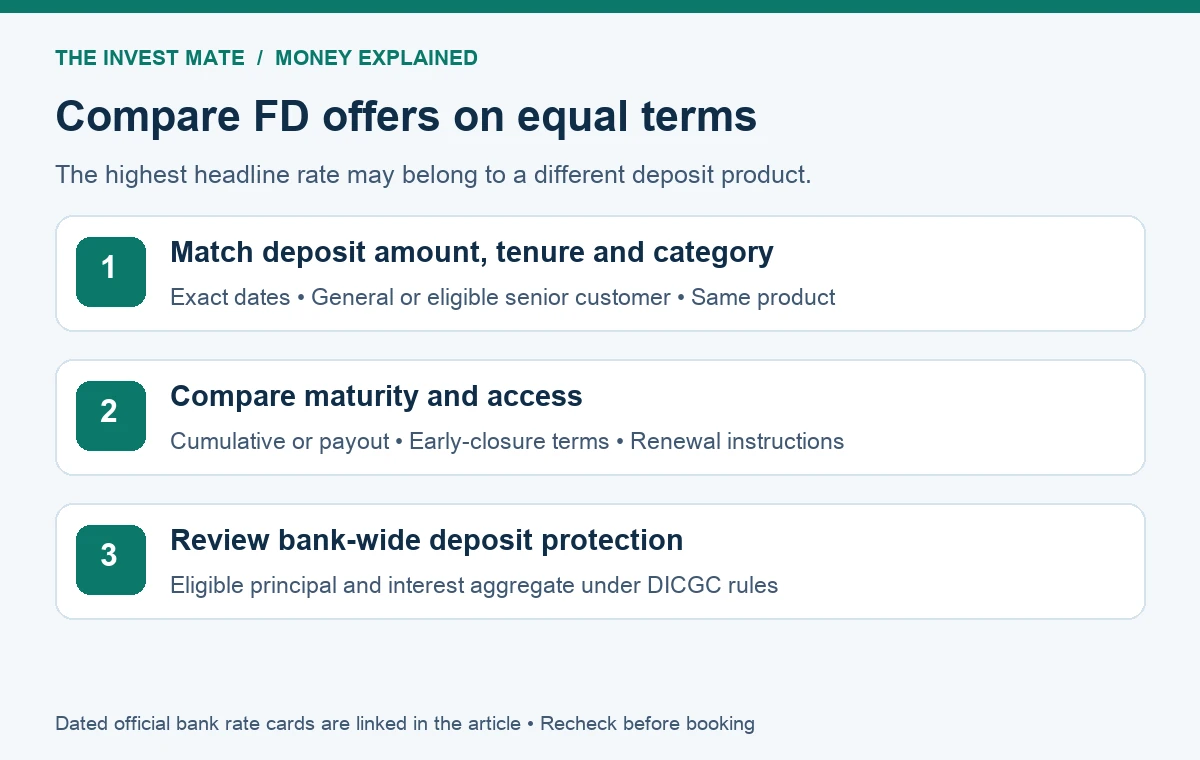
To compare fixed deposit interest rates, use the same deposit amount, exact tenure, customer category and withdrawal facility. A headline “up to” rate can apply to a different term or product from the one you need. Below is a dated snapshot for SBI, HDFC Bank and ICICI Bank, followed by a checklist for comparing the actual maturity amount.
In this guide
Rates checked: 8 October 2026. Selected domestic retail rates for deposits below ₹3 crore with premature-withdrawal facility. These are three selected banks, not an exhaustive ranking or a recommendation. Confirm the applicable rate with the bank when booking.
- 1. Match the deposit terms
Same amount, exact maturity date, category and product. - 2. Compare maturity and access
Check compounding, payout, early closure and renewal. - 3. Check bank-wide protection
Consider eligible principal and interest under DICGC aggregation rules.
SBI vs HDFC vs ICICI: selected FD rate comparison
| Bank and exact tenure | General (% p.a.) | Senior citizen (% p.a.) |
|---|---|---|
| SBI: 1 year to less than 2 years | 6.25% | 6.75% |
| HDFC: 1 year to less than 15 months | 6.25% | 6.75% |
| ICICI: 1 year to 389 days | 6.25% | 6.75% |
| SBI: 2 years to less than 3 years | 6.40% | 6.90% |
| HDFC: 2 years 1 day to less than 2 years 11 months | 6.45% | 6.95% |
| ICICI: 2 years 1 day to 3 years | 6.45% | 6.95% |
Official rate schedules: SBI shows revised retail rates effective 15 December 2025; HDFC Bank shows its below-₹3-crore schedule effective 19 August 2026; ICICI Bank shows rates effective 7 October 2026. Senior-citizen eligibility and product exclusions are governed by the respective bank's terms.
At exactly one year, these selected general-customer rates are equal. For a longer period, do not round your tenure to “two years”: an additional day can move the deposit into a different rate bucket. Bulk, non-callable, NRI and special-tenure offers require separate comparisons.
How much will ₹1 lakh earn?
Assume a cumulative deposit of ₹1 lakh for one year at 6.25% p.a., with quarterly compounding. The illustrative maturity is ₹1,06,398, giving ₹6,398 of interest before tax. To reproduce it, calculate (1 + 0.0625 ÷ 4) raised to the power of 4, then multiply by ₹1,00,000. Bank day-count conventions and rounding may produce a different quoted maturity.
Use the FD maturity calculator with the bank's quoted rate and compounding frequency. A monthly-interest payout FD does not accumulate interest in the same way as a cumulative deposit, so compare payout schedules separately.
Which FD is best for your needs?
- Match the maturity date to your goal. A higher rate on a long tenure may be unsuitable if you need the money earlier.
- Check early-closure terms. The bank may recalculate interest for the actual period held and then apply a penalty. A withdrawal facility does not mean early closure is free.
- Compare the final amount. Ask for the maturity quote, payout frequency and applicable deductions rather than relying only on the annual rate.
- Check deposit protection. Verify whether the institution and product are covered, and consider all your balances at that bank.
- Read renewal instructions. Automatic renewal can use the rate available at renewal, which can differ from the original rate.
Are bank FDs risk-free?
A contracted interest rate does not remove every risk. Under DICGC's deposit-insurance rules, eligible deposits at an insured bank are covered up to ₹5 lakh per depositor per bank in the same right and capacity, including principal and interest. Eligible balances across branches and accounts are combined for that limit. ₹5 lakh of principal can leave accrued interest above the insured ceiling.
Deposits above the coverage limit, access restrictions, inflation and reinvestment at a lower future rate still matter. Do not assume that a corporate or NBFC deposit has the same protection as an insured bank deposit.
FD interest and tax
For an ordinary resident bank FD, interest is taxable according to applicable income-tax rules. Tax deducted at source (TDS) is withholding, not necessarily your final tax liability. Eligibility for declarations that prevent withholding is conditional; low income alone is not a complete eligibility check. Consult the current rules for your financial year and circumstances.
A simple illustration: ₹6,250 of interest taxed at an assumed 20% leaves ₹5,000 before any cess or other adjustment. This illustrates why comparing gross rates alone can mislead. It is not a calculation of your personal tax.
Your FD comparison worksheet
Write down the exact maturity date before comparing offers. If one bank quotes a 24-month deposit and another quotes two years plus one day, request quotes for the same intended date. The rate bucket can change at that boundary.
| Field | What to record |
|---|---|
| Deposit and customer category | Amount, resident status and applicable age eligibility |
| Exact tenure | Start date, maturity date and bank rate bucket |
| Payout choice | Cumulative or periodic interest; compounding assumption |
| Access conditions | Callable or non-callable, penalty and actual-period calculation |
| Final quote | Maturity amount and renewal instructions |
| Other balances at this bank | Savings, other deposits and accrued interest in the same right and capacity |
What a 0.50-percentage-point rate difference changes
For a hypothetical ₹1 lakh cumulative deposit for exactly one year with quarterly compounding, 6.25% gives about ₹1,06,398, while 6.75% gives about ₹1,06,923 before tax. The difference is approximately ₹525. These are formula illustrations; 6.75% is not offered to every customer. Eligibility, the actual quote and early-closure costs still matter.
After a policy-rate announcement, check a fresh bank quote. Do not mechanically increase every FD rate by the repo-rate change. Our October repo-rate explainer distinguishes the policy benchmark from a bank's own product quote.
Common questions
Do small finance banks offer the best FD?
A higher advertised rate does not settle the comparison. Verify the official schedule, exact tenure, withdrawal conditions and insurance coverage. This table does not rank small finance banks.
Should I compare Post Office time deposits too?
They have separate scheme terms and government-notified rates. Compare the current scheme documents and applicable quarter's notification; do not assume bank-FD rules apply to them.
What if I save a fixed amount each month?
An FD models a lump-sum deposit. For monthly deposits, use our RD calculator and check the institution's compounding and installment rules.
Educational scope: Rates can change after the checked date. The worked examples exclude tax and early-closure costs. These source links are provided for verification; this guide does not recommend opening an account. See our disclosure and disclaimer.